What to Do When You Smell Something Burning From an Outlet?
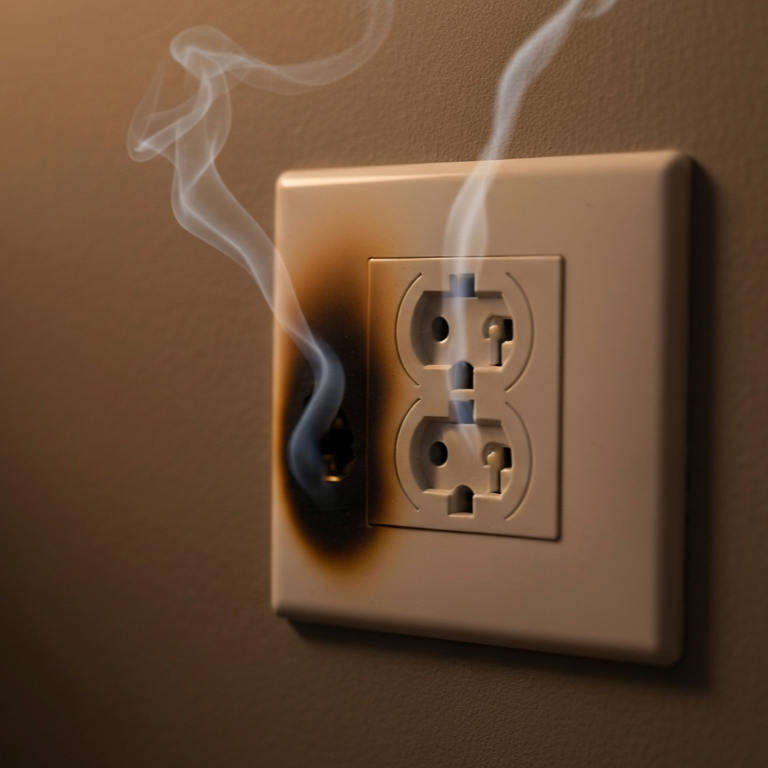
You walk into the room and smell it. Sour, plastic, faintly chemical. You follow your nose to a wall outlet that looks normal — maybe a little brown around the screw holes, maybe a faint warm feeling when you put your hand near the plate. There's no smoke. The lights are still on.
But don't wait. The smell is the warning, not the emergency. The emergency is what's still happening inside the wall.
Do These Five Things Right Now
1. Turn off the breaker for that outlet. Open the panel. If the labels are accurate, kill the one labeled for that room. If they're not, kill breakers one at a time until the outlet goes dead. Lights nearby may go off too — that's fine.
2. Unplug everything in the affected outlet. If you can do it without touching the receptacle or the wall plate, do it. If the plug feels hot, leave it for the electrician.
3. Unplug everything from outlets that might share the circuit. Other outlets on the same wall, outlets on the back side of the same wall, outlets in the next room. The whole circuit goes through one breaker; the failure could be at any device on it.
4. Keep people and pets away from the wall. Don't touch the outlet. Don't try to pull the cover off "just to see." The conductors inside the box may still be energized if you killed the wrong breaker.
5. Call a licensed electrician the same day. Not the next morning. Same day. If it's after hours, call the after-hours line. Tell them "burning smell at an outlet, breaker is off." They'll prioritize.
What's Actually Happening Behind the Wall
A burning smell from an outlet is the smell of plastic that's been heated past its melting point. Something inside the receptacle or in the wires behind it is running hot enough to char the device body, the conductor insulation, or both. The four most common causes are below — but figuring out which one is for the electrician, not for you.
| What's happening | What it usually looks like to an electrician |
|---|---|
| Loose connection inside the receptacle (backstabbed wire, loose terminal screw) | Discolored device body, scorch marks at the screw holes, melted plastic at the terminal |
| Loose wire nut or splice inside the box | Damage to the wire nut itself, charred insulation on the conductors entering the box |
| Overloaded circuit cooking the conductor | Heat damage that follows the conductor for several inches, not concentrated at one termination |
| Failed receptacle (worn brass contacts, internal arcing) | Damage centered on the receptacle itself, often without visible damage to the conductors |
And the breaker probably did not trip. A breaker monitors the circuit's total current and trips when it goes too high for too long. A loose connection draws normal current — the heat is local to the bad connection, not distributed across the circuit. The breaker has no way to see it.
So you have to kill the breaker manually. The protection that would normally save you isn't designed for this failure mode.
When You Can Plug Things In Again
Not until the electrician has been there, opened the device, found the cause, and either repaired or replaced it. Even if the smell goes away after a few hours, the underlying connection is still bad. It will heat up again as soon as you put a load on it — and the next time may be the fire.
The electrician's visit is usually one to three hours. They'll de-energize the circuit, pull the receptacle, find the failed connection, and replace whatever's damaged. If the damage extends into the wires behind the box, they may need to open a small section of drywall to make the repair. They'll also check the adjacent outlets on the same circuit — a failure at one location often means the next outlet down is close to its own failure.
After the work is done, the electrician energizes the circuit and tests it under load. The receptacle that was scorched gets replaced. Any conductor that shows heat damage gets cut back to clean copper. The new device gets terminated properly — on the screw terminals, not backstabbed.
When to Call Right Now vs. When to Wait
Most burning-smell calls are the same-day kind. There are a few situations where it's an immediate-911 kind — and a few where it can wait until the morning.
| What you're seeing | What to do |
|---|---|
| Smoke, flames, or audible popping from the outlet | Leave the house. Call 911. |
| Strong burning smell, warm wall plate, or visible scorch marks | Kill the breaker. Call a licensed electrician same-day, or after hours if needed. |
| Faint smell, no warmth, no visible damage, but you're sure it's the outlet | Kill the breaker. Call an electrician within 24 hours. Don't use the outlet until they've looked. |
| Burning-plastic smell that turns out to be a melting cord or appliance | Unplug the cord/appliance and discard it. The outlet itself may still be fine — but have it checked if there's any wall-plate discoloration. |
Frequently Asked Questions
No. The connection that overheated is still bad. Re-energizing it puts you back where you started, and the next thermal cycle can push the failed connection into a fire. The outlet stays off until an electrician has opened it.
That's actually a good sign — the breaker is doing its job. Leave it off. A breaker that won't reset means there's still a fault on the circuit that the breaker is detecting. The electrician will find and repair the fault and reset the breaker during the same visit.
AFCI breakers are designed to detect the electrical signature of an arc — the same kind of failure that causes burning smells. On a circuit protected by an AFCI, the breaker often trips before the smell appears. AFCIs are increasingly required on residential branch circuits for exactly this reason. If your panel doesn't have them on bedroom and living-area circuits, ask the electrician about retrofitting during the repair visit.
The receptacle replacement and circuit check is usually a one-to-three-hour service call. If the damage extends into the wires behind the wall, drywall repair adds to the timeline and cost. Compare any of that to the cost of a wall fire — the math is clear.
Routine repair of a single bad outlet isn't usually an insurance event. If the outlet failure caused actual fire or smoke damage to the wall, finishes, or contents, that's a claim. Take photos of the damage before any repair work starts.
Replaced. Once a receptacle has been cooked past its rating, the internal contacts aren't reliable anymore. The wires can be reused after they're stripped back to clean copper and re-terminated, but the device itself goes.
A Burning Smell Is the Loudest Quiet Alarm You'll Get
The breaker won't trip on this kind of failure. The smoke detector won't go off until there's actual smoke. The only warning you get is the smell — and once you smell it, the connection inside the wall has been failing for hours. Kill the breaker. Don't try to diagnose it yourself. Don't plug anything else in. Have a licensed electrician open the device, find the failure, and replace what's damaged before the circuit goes back into service.
