Why Outdoor Panels Rust Fast Near the Coast (and What Helps)
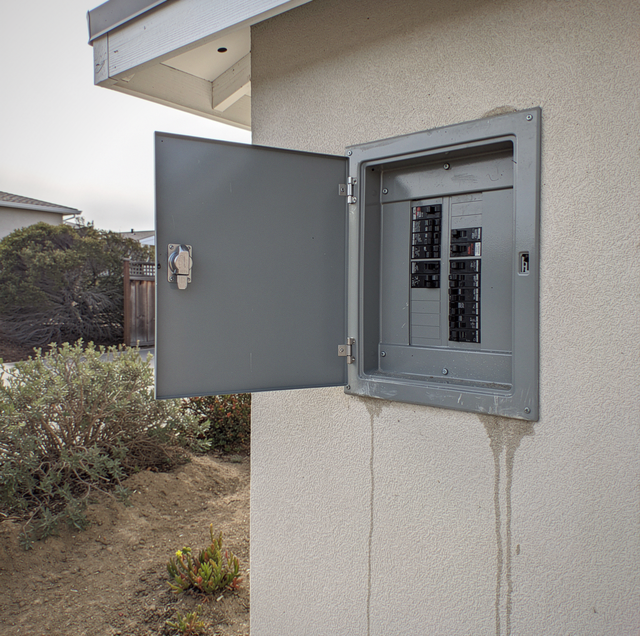
Start with the cover. Not the whole panel, just the dead front, the metal plate over the breakers. Pull it (or have an electrician pull it) and look at the screws holding it on. If they show rust bloom, orange-brown flaking rather than clean metal, that's the first, easiest sign that salt-laden moisture has been reaching this panel for a while. It's a five-minute check that tells you more about a coastal panel's actual condition than months of looking at it from the driveway, because the enclosure itself is usually built to hide what's happening inside for a surprisingly long time.
Step One: Understand Why Salt Air Attacks Faster Than Ordinary Weather
Ordinary rain and humidity slowly corrode exposed metal through oxidation. Salt-laden marine air speeds up that process considerably because dissolved salt in the moisture acts as an electrolyte, a substance that carries an electrical charge between metal surfaces. That electrolyte turns ordinary rust into something closer to a small battery: two different metals (say, a steel screw and an aluminum bus bar, or a brass lug and a galvanized enclosure) sitting in salty moisture will corrode each other through galvanic action, a reaction that eats away at whichever metal is more reactive far faster than plain rust would on its own. This is why a panel a mile inland can look fine for decades while a similar panel near open coastline shows pitting and flaking within a handful of years, even with identical rainfall.
Step Two: Check the Gaskets, Not Just the Metal
The enclosure's weatherproofing depends less on the metal box itself than on the rubber or foam gasket that seals the cover to the frame. That gasket keeps salt-laden moisture from working its way inside during wind-driven rain or heavy marine layer. Gaskets degrade with UV exposure and age regardless of coastal proximity, but in a marine environment a failed gasket has a much shorter path to real damage, since the air reaching the inside of a compromised seal already carries the salt content that speeds corrosion once it's in contact with the bus bar and breaker lugs.
A panel with an intact NEMA 3R rating (the standard weatherproof designation for outdoor electrical enclosures) resists wind-driven rain by design, but that rating assumes the gasket is still doing its job. An aged, cracked, or missing gasket on an otherwise correct enclosure defeats the rating entirely, which is why a visual check of the seal itself, not just the panel's listed rating, matters during any coastal-property inspection.
Step Three: Look for These Specific Corrosion Patterns
| What you see | What it usually indicates |
|---|---|
| Rust bloom on exterior screws and hinges | Surface corrosion; often cosmetic if the interior is dry, but worth confirming |
| White, powdery buildup on aluminum conductors or the bus bar | Aluminum oxide forming at a connection point, which increases resistance and generates heat under load |
| Green-blue crust on brass or copper lugs | Copper corrosion product, a sign moisture has been reaching those connections repeatedly |
| Pitting or flaking on the enclosure's interior back wall | Long-term condensation or moisture intrusion, often tied to a gasket that failed a while ago |
| A breaker that feels loose in its clip or shows discoloration around the base | Corrosion at the breaker-to-bus connection point, a heat and arcing risk regardless of what caused it |
The white, powdery aluminum oxide pattern deserves particular attention, because that oxide layer is itself an insulator. As it builds at a connection point, it increases electrical resistance right where the current is trying to pass, and the resulting resistance under load generates heat. A connection slowly oxidizing at the bus bar behaves a lot like a loose wire nut: fine for a long stretch, then increasingly prone to a hot spot as the oxide layer thickens.
Step Four: Weigh Repair Against Replacement
Not every corroded panel needs full replacement. Surface rust on an enclosure's exterior, caught before it reaches the interior components, is often addressed by replacing the gasket and applying a protective coating to the exposed metal. Corrosion that's reached the bus bar, the breaker lugs, or the main breaker's internal contacts is a different situation: those parts aren't something that gets cleaned and reused safely, since a bus bar with pitted contact points won't seat breakers evenly no matter how thoroughly it's cleaned. At that stage, panel replacement, sometimes paired with relocating the panel slightly farther from direct salt spray or under better overhang protection, is the more durable fix than repeated repair cycles on a panel that's already structurally compromised.
Step Five: Choose Materials Built for the Exposure, Not Standard Stock
A standard residential panel enclosure, gasket, and hardware are engineered for typical inland conditions. A coastal replacement benefits from marine-rated or corrosion-resistant hardware: stainless steel screws instead of standard zinc-plated steel, an enclosure finish rated for salt-spray exposure, and connectors treated with an antioxidant compound at aluminum-to-copper junctions specifically to slow the galvanic process described earlier. None of these substitutions change how the panel functions electrically. They change how many years pass before the same corrosion cycle starts again.
Step Six: Build in a Simple Recurring Check
A panel near the coast benefits from being opened and visually checked more often than one farther inland, since corrosion here progresses faster and the enclosure hides the early stages well. A quick look at the gasket, the screws, and a glance at the bus bar through the opening (without touching anything live) once every year or two catches the surface-rust stage while it's still a low-cost fix, rather than finding out only when a breaker starts acting up, or a whole-house outage traces back to a corroded main lug.
Overhangs and orientation matter more than most homeowners assume, too. A panel mounted under a deep roof overhang, facing away from the prevailing onshore wind, receives a fraction of the direct salt spray that a fully exposed panel on a windward wall receives over the same number of years. When a replacement is already on the table, shifting the mounting location by even a few feet or adding a simple rain hood above an existing enclosure is a low-effort change that meaningfully slows the whole process described above.
Six steps, but one habit carries most of the weight: pulling that cover on a regular schedule, not only once something already looks off. A coastal panel corrodes on its own clock, indifferent to how good the enclosure looks from the driveway, which is exactly why the five-minute check this piece opened with is worth repeating for years after the panel first goes in, not just the one time a rusty screw happens to catch someone's eye.
Frequently Asked Questions
A protective, exterior-rated coating over sound metal can slow surface oxidation, but paint alone doesn't address a failed gasket or corrosion already present at internal connections, and painting over active rust without addressing the underlying metal often traps moisture rather than blocking it.
Airborne salt concentration drops off sharply with distance from open water and elevation, so a property directly exposed to onshore wind and spray sees meaningfully faster corrosion than one just a short distance inland or shielded by a ridge or row of buildings, which is one reason two nearby homes can show very different panel conditions at the same age.
Yes, and it's a common recommendation during a full panel replacement on an exposed property. Moving the panel any real distance from its current spot usually means moving the service drop or meter attachment point along with it, which requires utility coordination and its own permit, so the relocation is planned as part of the replacement project rather than added on afterward. Even a modest shift toward a more sheltered wall, under an eave and away from direct onshore wind, meaningfully slows the corrosion cycle compared to a fully exposed location.
Indoor panels are far more sheltered, but a detached garage, an exterior disconnect, or any wiring in an unconditioned crawlspace with outside air infiltration can also experience accelerated corrosion, just at a slower rate than a fully exposed outdoor enclosure.
There's no fixed number, since exposure varies with exact location and shielding, and it isn't solely about age. A standard galvanized enclosure in a fully exposed coastal spot can show real bus bar or lug corrosion within roughly five to ten years, while the same enclosure built with stainless hardware and a marine-rated finish, or simply mounted somewhere sheltered, can stretch well past that before showing comparable wear. That's why the panel's exact hardware and mounting location matter as much as its calendar age when estimating how much time it has left, which is why coastal properties benefit from more frequent visual inspections rather than relying on a standard replacement timeline.
Often faster, since many surge protection devices mount with smaller connectors and thinner metal than the main panel components, giving galvanic corrosion less material to work through before a connection point fails, which is worth checking during the same visual inspection as the panel itself.
Schedule an outdoor panel inspection — catch coastal corrosion at the gasket and connection stage before it reaches the bus bar. Ridgeline Electric serves Santa Cruz and the surrounding area. Call (831) 206-5602.
