
Why Is the Power Out in Only One Room?
You walk into the spare bedroom to grab the laundry, and the lamp doesn't turn on. The clock on the dresser is blank. You flip the wall switch — nothing. You check the breaker panel, and every breaker is in the "ON" position. The rest of the house works fine.
And this is one of the most common electrical service calls — and one of the easiest to diagnose if you check things in the right order. But the cause is usually one of four things. Three of them you can find in the next five minutes without calling anybody. The fourth one is when you call.
Check These Four Things In Order
| Step | What to check | What it looks like when this is the cause |
|---|---|---|
| 1 | Every GFCI outlet in the house | One of them has a tripped reset button (popped out, often with a red or black indicator showing). Pressing "Reset" restores power to the affected room. |
| 2 | Every AFCI breaker in the panel | The handle looks normal, but the breaker is actually tripped — it sits in a middle position between ON and OFF. Push it fully OFF, then back to ON. |
| 3 | The wall switch that controls the affected outlets | The switch is off, or the room has a switched outlet that's not getting power because something on the switch is off (often a light bulb that needs replacing). |
| 4 | A loose connection on the circuit | None of the first three fixes the problem. Now it's electrician time. |
So work through them in that order. The first three take five minutes and don't cost anything. Skipping to step 4 every time is how you spend service-call money on problems your kid could have solved.
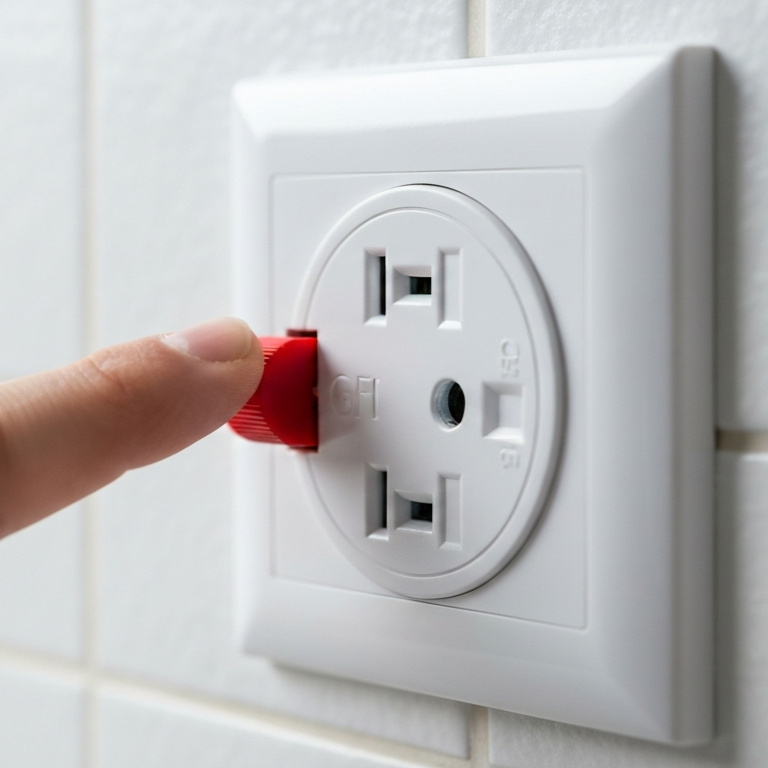
Step 1: Find the Tripped GFCI
This is the answer most of the time. GFCI receptacles — the ones with the "TEST" and "RESET" buttons in the middle — protect not just themselves but also the outlets downstream from them on the same circuit. A GFCI in the bathroom often protects outlets in nearby rooms. A GFCI in the garage often protects outdoor outlets and outlets in an adjacent room. A GFCI in the kitchen often protects the dining room circuit.
Walk through every bathroom, the kitchen, the garage, the laundry room, and any outdoor outlets you can reach. Look at every GFCI receptacle. A tripped one has a "RESET" button that's popped out further than the "TEST" button. Some models show a red or black indicator. Press "RESET" firmly. The power to the affected room usually comes back at that moment.
If pressing reset doesn't hold — the button pops back out within seconds — there's a real fault on the circuit somewhere, and that's the GFCI doing its job. Leave it tripped and call an electrician.
Step 2: Check Your AFCI Breakers
AFCI breakers — arc-fault circuit interrupters — are the breakers in your panel that protect against arcing faults rather than just overcurrent. They look identical to standard breakers from the outside, except for a little colored test button on the face.
When an AFCI trips, sometimes the handle moves to a clearly OFF position, and you can see it. Sometimes the handle just shifts to a middle position — not quite ON, not quite OFF — and a casual glance reads it as normal. That's a silent trip.
Walk down the row of breakers in your panel. Push each one firmly to the full OFF position, then back to the full ON. If one of them was silently tripped, the resistance you feel is different — the handle has to travel further to OFF than the ones that are actually still on. Resetting it restores power.
If the AFCI immediately trips again, something on the circuit is producing the arc-fault signature it's designed to detect — and that's the breaker doing its job. Leave it off and call an electrician.
Step 3: Check the Wall Switch
Some rooms have outlets that are wired to a wall switch — usually one outlet per room, half-switched (the top half is switched, the bottom half is always on), or a single switched outlet meant for a floor lamp. If the lamp you tested is plugged into that outlet and the switch is off, no power gets to it. This is the simplest possible cause and it's surprisingly common, especially when somebody moved furniture and bumped a switch nobody uses.
Flip every wall switch in the affected room. Test the outlets again. If they come on, the switch was off. If they don't, move to step 4.
Step 4: If None of That Worked, You Have a Loose Connection
If the GFCIs are all fine, no AFCI was tripped, and the switches are all on, the cause is almost always a loose connection at a device on the affected circuit. The connection has separated enough to break the electrical path but not enough to short or arc dangerously — yet. The room loses power.
The loose connection is usually one of three places:
A backstabbed wire at an outlet on the circuit. Older outlets allowed the installer to push a stripped wire into a hole on the back of the device. Over years of thermal cycling, the wire works loose. When the connection separates entirely, downstream outlets on the same circuit lose power.
A loose terminal screw or wire nut in a device box. Same physics as the backstab — thermal cycling and gradual settling work the connection loose. Eventually, it opens.
A failed switch. A switch that's been operated tens of thousands of times can develop a bad internal contact. The switch reads "on" but no longer makes a solid connection.
The electrician's job is to find which device on the circuit has a bad connection. They start by mapping the circuit — pulling the cover off the first outlet and tracing the wiring from there. The bad connection is usually at the device immediately upstream from the first outlet that has no power. A 30-minute mapping visit usually finds it.
When to Call an Electrician (Not Just Wait It Out)
Don't keep trying to reset things if any of the following are true:
A breaker or GFCI trips immediately when you reset it
You smell burning plastic anywhere in the house
A receptacle or wall plate feels warm
You see scorch maons at any device on the affected circuit
The whole house had a brief flicker or surge before the room went dark
Any of this means there is an active fault on the circuit, and continuing to reset is putting more thermal cycles on whatever is failing. Call same-day.
Frequently Asked Questions
The breaker monitors excessive current on the circuit. A loose connection doesn't pass much current — it just stops conducting altogether. From the breaker's perspective, the circuit looks fine; from your perspective, the room is dark. That's why nothing in the panel looks wrong. GFCI and AFCI devices monitor different signals and trigger on different conditions, which is why they catch what a standard breaker misses.
Yes — and often does. GFCI receptacles protect everything downstream of them on the same circuit. The circuit can run through multiple rooms before terminating, and the GFCI at the front of the run protects all the outlets behind it. This is by design, but it surprises people who didn't know the bathroom outlet was the master switch for the bedroom.
Check every bathroom, kitchen counter, laundry, garage, and outdoor outlet — including ones behind furniture or in closets. GFCIs sometimes get installed in unusual locations. If you genuinely can't find one and the AFCI step also didn't help, it's time to call the electrician.
Probably worth doing on bedrooms and living-area circuits, especially in older homes. AFCIs catch the kind of arcing failure that causes outlet fires before it gets dangerous. They cost more than standard breakers and they install in the same slot.
The diagnostic visit is usually one hour. The repair itself — once the faulty device is found — it usually takes another hour. Most one-room power-out calls resolve in a single short service visit unless the damage extends into wires that need to be opened up.
In older homes, sometimes yes — rodents chewing through wire insulation in attics or crawlspaces. Squirrels in soffits. Rats in basements. Not the most common cause, but if the electrician finds chewed insulation, that's what happened.
Five Minutes Before You Call
This is the call where homeowners most often pay for a service visit that could have been a button press. Walk the GFCIs first. Push every AFCI fully off and back on. Check the wall switches. Most of the time, the answer is in one of those three places. When it isn't, an electrician can find the loose connection on the circuit in a single visit — and replace whatever device went bad before it becomes a bigger problem.
