
LED Retrofit vs New LED Fixtures: Which Saves More for Commercial Buildings
A facility manager walks into the office of an electrical contractor with a fluorescent-lit warehouse, a rising power bill, and a question: Should we retrofit or replace?
The contractor's answer shouldn't be "replace everything" without doing the math. And it shouldn't be "retrofit everything" without looking at the fixtures.
What you do comes down to what's already in the ceiling, how the building uses lighting, what the local energy code triggers when major work happens, and how long the company plans to occupy the space. The spread between the two approaches can be meaningful — sometimes 50% or more of project cost — and the payback periods can differ by years.
Here's a plain-English look at the trade-offs between LED retrofit kits and full fixture replacement.
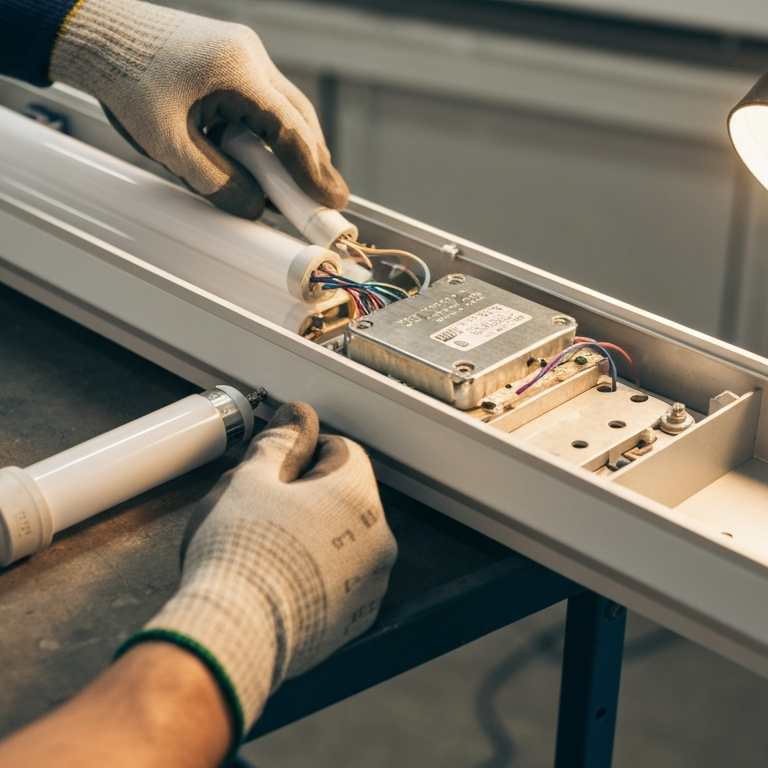
What "Retrofit" Actually Means
An LED retrofit reuses the existing fixture housing — the metal box mounted to the ceiling, the lens, the reflector — and replaces only the lamps and the ballast inside.
The simplest retrofit is a direct lamp swap. The fluorescent tubes come out. LED tubes go in. The fluorescent ballast either stays (for "ballast-compatible" LED tubes) or gets bypassed (for "ballast-bypass" tubes that wire straight to line voltage). Fast work — a maintenance crew can do dozens of fixtures in a day.
A more thorough retrofit uses a retrofit kit: a complete LED light engine and driver designed to drop into a standard fixture housing. The old lamps and ballast come out, the kit mounts into the existing housing, the wiring connects to the building's circuit, and the fixture is essentially new inside a familiar shell.
A full fixture replacement is different. The entire fixture comes off — housing, lens, reflector, wiring connections at the ceiling — and a purpose-built LED fixture goes in its place. Different scope. Different price point.
Where the Savings Actually Come From
Three things drive the savings math on a lighting upgrade, and they apply equally to retrofits and full replacements.
Wattage reduction. A standard fluorescent troffer pulls roughly 60 to 90 watts, including ballast losses. An equivalent LED retrofit or new fixture pulls 25 to 45 watts. The wattage drop is roughly 50%, sometimes more. And that drop runs every hour the lights are on.
Run time. A retail space lit 12 hours a day, six days a week, sees that wattage drop add up to thousands of kilowatt-hours a year. A warehouse with 24/7 lighting sees it add up to many times more. Run time is the multiplier that makes the savings real.
Maintenance savings. A fluorescent lamp lasts roughly 15,000 to 25,000 hours. An LED retrofit or fixture lasts 50,000 to 100,000 hours. For a building that pays staff or a contractor to replace lamps on a ladder, maintenance savings can rival the energy savings over five years.
The wattage drop is the same whether you retrofit or replace. The savings on the electric bill are roughly equivalent. The difference between the two approaches is mostly in the installation cost — not in the long-term energy bill.
The Installation Cost Difference
A retrofit kit and an LED replacement fixture have similar material costs. The difference is in labor.
A lamp swap is the cheapest installation. An electrician unclips the old tubes, drops in the new ones, moves on. Some retrofit kits are nearly as fast, especially in standard 2x4 troffers that ship with a pre-wired tray that drops in from below.
But a full fixture replacement is meaningfully more labor-intensive. The old fixture has to come off the ceiling. The ceiling tile may have to come down. The wiring has to disconnect at the junction box. The new fixture has to physically fit the opening. The wiring has to reconnect. The ceiling tile has to go back. And the controls have to be tested. In a working office or retail space, that's also work that has to happen after hours, which adds a labor premium.
The labor difference can be 50% to 200% on a per-fixture basis, depending on what kind of fixture is being replaced. Across a building with several hundred fixtures, that adds up fast.
When Retrofit Is the Right Call
A retrofit makes the most sense when the answers to these questions line up:
Are the existing fixture housings in good shape? No rust, no water damage, no broken lenses, no missing parts.
Is the existing layout still serving the space? No major changes in how the room is being used.
Is the existing wiring sound? No exposed cables, no failed connections, no improvised splices.
Are the existing controls adequate? Either already compliant with current standards or being upgraded separately.
When those four boxes are checked, a retrofit captures most of the energy savings, pays back faster than a full replacement, and disrupts the building less.
When Full Fixture Replacement Is the Right Call
Full replacement starts to win on a few specific conditions.
The existing fixtures are damaged. Rusted housings in a warehouse, water-stained tiles, cracked lenses, and fixtures with missing parts. Retrofit kits don't fix those problems. They put new LEDs inside a fixture that still looks bad and still has reliability issues.
The building is being renovated anyway. When the ceiling is already coming down, the labor premium for full replacement nearly disappears. Switching from full replacement to retrofit in that scenario saves much less than you'd expect.
The lighting layout needs to change. If a warehouse is being reconfigured and the racking is moving, the lighting needs to follow. A retrofit doesn't move fixtures. It just upgrades the ones already there.
The local energy code triggers controls upgrades. Many jurisdictions require occupancy sensors, daylight harvesting, dimming controls, or zoning when a "major" lighting upgrade is done. Some retrofit kits work with those controls. Some don't. Full replacement gives you a clean integration with modern controls in every fixture.
A high-bay or specialty application needs purpose-built fixtures. High-bay LED fixtures, exterior pole lights, and refrigerated-case lighting are usually better as full replacements. The thermal management, optics, and IP rating of the housing matter as much as the LEDs themselves.
The Energy and Payback Math, Generically
The exact savings depend on the building's electric rate, the run time, and the wattage drop. But the structure of the math is consistent.
| Variable | Typical commercial range |
|---|---|
| Wattage drop per fixture | 25–50 watts |
| Run time per year | 2,000–8,000 hours |
| Energy saved per fixture per year | 50–400 kWh |
| Cost savings per fixture per year | Dollars to tens of dollars, depending on rate |
| Maintenance savings per fixture | Significant over a 5-year horizon |
For a typical office with 200 fixtures running ten hours a day, the annual savings can be in the low five figures. For a warehouse with 100 fixtures running around the clock, the savings can be considerably higher.
Payback on retrofits often lands in the two-to-four-year range. Payback on full replacements often runs four to seven years. Utility rebates, tax incentives, and financing change those numbers — sometimes substantially.
Rebates and Incentives, Briefly
Many utilities offer rebates for commercial lighting upgrades. Federal and state tax incentives can apply when the upgrade meets certain energy-savings thresholds. Eligibility rules and dollar amounts change year to year and vary by jurisdiction.
A few rules of thumb:
Rebates are usually paid per fixture replaced or per watt reduced.
Rebate paperwork has to be filed before the installation in many programs, not after.
Tax incentives generally require energy modeling documentation.
A contractor experienced with commercial lighting upgrades knows which programs apply in your area and how to file.
Don't bake unrealized rebates into the project budget. Treat them as a refund that may or may not arrive on the timeline you expect.
Controls Compatibility
This is where retrofits sometimes lose the math, even when they win on installation cost.
Modern commercial energy codes require lighting controls in most spaces. Occupancy sensors that turn lights off when no one is in the room. Daylight sensors that dim the lights when sunlight is present. Zoning that lets different parts of an open floor plan be controlled separately.
Some LED retrofit kits handle those controls beautifully — they ship with dimming drivers and 0–10V or DALI-compatible control wiring. Some retrofit kits, especially the cheapest ballast-bypass tubes, don't dim at all and can't accept any external control signal. If the project requires dimming or occupancy control and the chosen retrofit can't deliver it, the savings story falls apart.
Full replacement fixtures are designed for control integration. The driver, the optics, and the wiring are all designed together. For a building that needs sophisticated controls, full replacement is often the simpler path.
A Real-World Mixed Approach
Most commercial lighting projects don't use a single approach for the entire building. The right move is usually a mix:
Retrofit kits in the office areas where the housings are sound, and the controls are simple.
Full replacement in the warehouse where the high-bays are old, the controls need an upgrade, and the layout is changing.
Lamp swaps in storage rooms and back-of-house areas where the only need is wattage reduction.
A walk-through with an experienced lighting contractor sorts each space into the right category. The project then becomes a hybrid scope with two or three different installation profiles, priced and scheduled separately.
What a Real Walk-Through Quote Should Cover
A thorough commercial lighting upgrade quote starts with a building walk and ends with a written scope. The contractor should:
Count and categorize every fixture in the building
Note the condition of each fixture (sound, marginal, damaged)
Document the existing controls and what code requires going forward
Measure run times for each space if not already documented
Pull the current electric bill and the utility's rate schedule
Identify available rebates and incentives
Propose the installation approach for each space, with a per-fixture cost
Provide an estimated payback period based on the actual building numbers
Anything less is a guess, not a proposal. A quote that says "replace all fixtures, $X total" without the underlying analysis is hard to compare against a more thorough bid and harder to justify to leadership.
Frequently Asked Questions
Sometimes, sometimes not. Older incandescent dimmers don't work with most LED drivers, and even some newer dimmers have compatibility issues with specific LED products. Your contractor should test compatibility before committing to the project. Replacing the dimmers along with the lamps adds a small line item but prevents flickering and humming issues later.
For a single room, sometimes. For a commercial building, it's almost never the right call. Many retrofit configurations require rewiring the fixture, removing or bypassing the ballast, and re-marking the fixture's listing label. A licensed electrician does that work to code and signs off on it. Doing it informally voids the fixture's listing and can complicate insurance claims.
Manufacturer ratings are usually 50,000 to 100,000 hours at a given temperature and drive current. Real-world life depends on how hot the fixture gets and how hard the driver is pushed. A high-bay running at full output in an unconditioned warehouse may not hit its rated life. A 2x4 troffer in a conditioned office almost always does, and often exceeds it. The driver typically fails before the LEDs.
No. Many buildings phase the upgrade — start with the highest run-time spaces (the warehouse, the parking lot, the 24-hour areas) where the payback is fastest, then expand into the office and back-of-house areas as budget allows. Phasing also lets you confirm the chosen product works well in the building before committing to the rest.
Probably brighter, and possibly different in color temperature. Older fluorescent tubes have drifted in output over the years. The new LEDs hit their full rated lumens on day one. If color temperature matters in the space — retail, art galleries, restaurants — the contractor should match the spec to the room's purpose and let you see a sample before committing.
Don't Pick One Approach for the Whole Building
The biggest mistake in commercial lighting upgrades is treating the building as a single retrofit or replacement project. Real buildings have a mix of fixture conditions, run times, and control needs — and the most efficient project is the one that matches the installation approach to each space. A walk-through that produces a per-space scope, with a per-fixture cost and an honest payback by area, is the difference between a project that pays back as advertised and one that runs long and over budget.
