
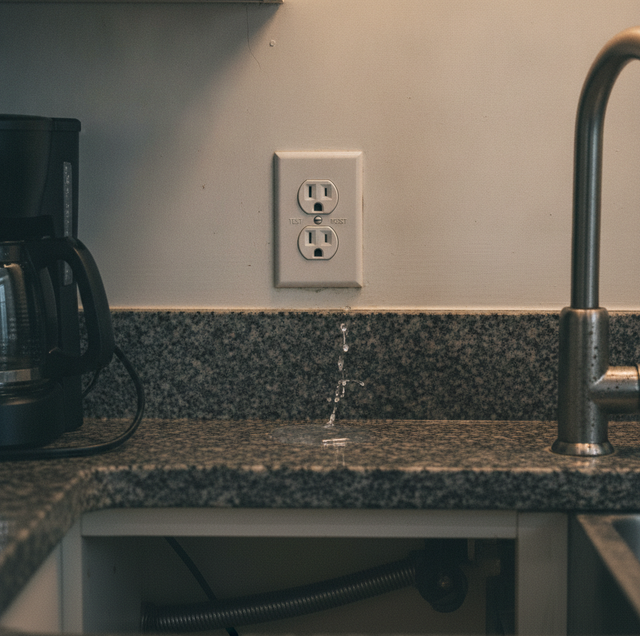
You have probably noticed them: outlets with two small buttons, one marked TEST and one marked RESET, usually in the kitchen, the bathroom, or by the back door. That outlet is a GFCI, short for ground-fault circuit interrupter, and it does a job an ordinary outlet cannot. It watches, moment to moment, for the specific electrical event that shocks people, ready to cut power before that event can hurt anyone.
Most homeowners never think about a GFCI until it trips at an inconvenient time. But knowing what it does, and where a home should have one, is worth a few minutes. It is one of the small pieces of a house that quietly stands between a person and a serious injury.
Quick Answer: A GFCI outlet protects people from electric shock. It constantly compares the current flowing out on the hot wire to the current returning on the neutral. If even a tiny amount, roughly four to six milliamps, leaks off to ground, for instance, through a person, it trips and cuts power in a fraction of a second. That is a different job from a normal breaker, which protects wiring from overload. GFCIs belong wherever electricity meets water: kitchens, bathrooms, laundry rooms, garages, unfinished basements, outdoors, and near pools.
How a GFCI Actually Works
Electricity in your home runs in a loop. Current leaves the outlet on the hot wire, passes through whatever you have plugged in, and returns on the neutral wire. In a healthy circuit, those two amounts match almost perfectly.
A GFCI is built around that balance. A sensor inside measures the hot and neutral currents at the same time and compares them. As long as they are equal, power keeps flowing. The instant they stop matching, the GFCI knows some current has found another way back, a path that is not the neutral wire: it is leaking to ground.
This matters because the human body is one of those alternate paths. If a hairdryer falls into a filled sink, or a person touches a live part while standing on damp concrete, current flows through the body to ground rather than returning to neutral. A GFCI catches that imbalance while it is still tiny. It reacts at a difference of about four to six milliamps, well below what causes a dangerous shock, and opens the circuit in a fraction of a second, cutting power before the current through a person climbs to a harmful level.
Consider a scale with two pans that must stay level. Load the same weight on each side, and the beam holds flat; slip even a small weight off one side, and it tips at once. A GFCI is that watchful beam, and the tip is the trip.
Why a GFCI Is Not the Same as a Breaker
This is the distinction that trips people up. A standard breaker protects the wiring: it stops too much current from flowing through a circuit. If you plug in too many space heaters, or a wire shorts and current spikes, the breaker senses that overload and shuts off before the wire can overheat and start a fire. The amount of current that can kill a person is far below the level that would ever make a breaker notice.
A GFCI protects people. It ignores the total current, which could be perfectly normal, and looks only at whether the hot and neutral are balanced. A small leak to ground that a breaker would never react to is exactly what a GFCI is built to catch. The two are not redundant: a circuit can have both, one keeping the wiring from overheating, the other keeping a person from being electrocuted.
Where Your Home Needs GFCI Protection
The rule of thumb is simple: wherever electricity and water can meet, or the floor might be damp, you want GFCI protection. Water gives electricity an easy path to ground, and a person standing near it becomes part of that path.
In practice, that means these areas:
- Kitchens, the outlets serving countertops where appliances sit near sinks.
- Bathrooms, where outlets are close to sinks and tubs.
- Laundry areas, near the washer and the utility sink.
- Garages, where floors are concrete, often damp, and power tools are used.
- Unfinished basements, for the same concrete-and-moisture reasons.
- Outdoors, including exterior outlets, porches, and patios exposed to rain.
- Near pools, spas, and wet bars, where standing water is a constant.
The common thread is a likely shock path to ground. A bedroom outlet on dry carpet is a very different risk than an outlet a foot from a kitchen faucet, and protection is placed accordingly. If you are unsure whether an outlet in a wet or damp spot is protected, that is a fair question for a licensed electrician, since older homes were often built before this protection was expected in as many places as it is now.
The Three Kinds of GFCI
GFCI protection comes in a few forms, and they can be mixed within one house.
The GFCI receptacle is the one you picture, the outlet with TEST and RESET buttons on its face. It protects anything plugged into it, and it can protect other outlets too.
The GFCI breaker lives in the panel and looks like a normal breaker with an added test button. Instead of protecting a single outlet, it provides GFCI protection to the entire circuit the breaker feeds, so every outlet, light, and device on that run is protected from the panel.
The portable GFCI is a plug-in unit, common on jobsites and useful for temporary outdoor work. You plug it into a regular outlet, plug your tool into it, and it adds ground-fault protection wherever you are working.
Which approach fits a given home depends on how the circuits are wired, a decision an electrician makes based on the specific panel and layout.
One GFCI Can Protect Several Outlets
A single GFCI receptacle has two sets of terminals: LINE, which brings power in, and LOAD, which sends protected power onward to other outlets along the same circuit. When downstream outlets are wired through the LOAD terminals, they get the same protection even with no buttons of their own. It explains a common head-scratcher: you lose power at a garage outlet and eventually find the tripped GFCI in the bathroom on the other side of the wall. They share a circuit, and the bathroom GFCI was protecting the garage outlet all along. When power vanishes at an outlet with no buttons, look for a tripped GFCI elsewhere on that circuit and press its RESET.
The Monthly Test That People Skip
A GFCI is a mechanical and electronic device, and like anything, it can wear out or fail. A failed GFCI can still pass power and look completely normal while no longer protecting anything, so you would never know until the moment you needed it.
That is what the TEST button is for. Pressing TEST simulates a ground fault; on a working unit, the RESET button pops out, and power cuts off, proving the device can still trip, and pressing RESET restores it. Doing this once a month takes seconds and confirms the protection is real.
If a GFCI will not reset, or if pressing TEST does not cut the power, the device has likely failed and needs replacing. Because that swap involves the outlet wiring, and getting the LINE and LOAD terminals right matters for whether downstream protection still works, it is a job for a licensed electrician rather than a guess-and-check project.
When a GFCI Keeps Tripping
An occasional trip is the device doing its job. A GFCI that trips over and over is telling you something, usually that it has found a real problem, not that it is being fussy.
Outdoor units are the frequent offenders, for physical reasons: moisture works into the receptacle, a weatherproof cover gets left open in the rain, or a tool plugged in downstream has developed a fault and is leaking current to ground. In every case, the GFCI is reacting to an actual ground fault, exactly what it is supposed to do, so a repeat trip is best treated as a fault to locate, not a nuisance to defeat.
The wrong response is to keep resetting it, or worse, to swap in a plain outlet to stop the tripping, which removes the protection precisely where the risk is highest. If a GFCI trips repeatedly and the cause is not obvious, have an electrician trace the circuit and find the fault.
GFCI, AFCI, and the Standard Breaker
The three protective devices cover three separate dangers.
- A standard breaker protects wiring from overload and overcurrent. It stops a wire from overheating.
- A GFCI protects people from shock. It catches the current leaking to ground.
- An AFCI, or arc-fault circuit interrupter, protects against fire. It watches for the erratic electrical arcing of a damaged or loose wire, the kind of sparking that can ignite surrounding material, and shuts off when it detects that signature.
Because these are three different hazards, a home often uses more than one, and some devices combine GFCI and AFCI functions in a single unit. The takeaway is not to treat them as interchangeable: a GFCI in a bathroom and an AFCI protecting a bedroom circuit guard against completely different failures, and both have their place.
Leave the Panel Work to a Professional
Testing a GFCI monthly, resetting a tripped one, and hunting for the source when it keeps tripping are reasonable things to handle yourself. Replacing a GFCI, adding one where a wet-area outlet lacks protection, wiring a GFCI breaker into the panel, or chasing a persistent ground fault are different matters. Those involve the LINE and LOAD terminals and sometimes the panel itself, where a mistake can leave protection disabled without any obvious sign. Panel and wiring work is a licensed electrician job, and a GFCI that keeps tripping is never something to ignore, because it points to a real fault that deserves to be found and fixed.
Frequently Asked Questions
A regular breaker protects the wiring from drawing too much current, so it reacts only to overloads that could overheat a wire, a threshold measured in whole amps. A GFCI instead trips at only about four to six milliamps, thousands of times shorter than the level that protects a person from a shock. It also reacts fast at that small leakage, in roughly a fortieth of a second, about 25 milliseconds, far quicker than a standard breaker responds to an overload. They guard against different dangers, which is why a circuit can carry both.
Anywhere electricity meets water or damp conditions: kitchen counter outlets, bathrooms, laundry areas, garages, unfinished basements, outdoors, and near pools or wet bars. Those are the spots where a shock path to ground is most likely, because water lowers the body's resistance and lets current flow more easily. Homes built before the protection was common in these areas are often retrofitted with GFCI receptacles during upgrades.
Pressing TEST creates a small internal imbalance that simulates a ground fault, and a healthy outlet responds by tripping and cutting power; RESET restores it. Testing once a month confirms the protection still works before you need it. A useful habit is to plug in a lamp first: if it goes dark when you press TEST and lights again after RESET, the device is proving both halves of its job in a few seconds.
Yes. A GFCI receptacle has LINE terminals that bring power in and LOAD terminals that pass protected power onward. When downstream outlets are wired through the LOAD terminals, they are covered too, even with no buttons of their own. There is a catch worth knowing: if those downstream outlets are mistakenly connected to the LINE terminals instead of the LOAD, they still get power and work normally, but they receive no ground-fault protection at all, so a miswire can leave outlets unprotected while everything appears fine.
Outdoor units often trip because of real moisture getting into the receptacle, a weatherproof cover left open in the rain, or a fault in a device plugged in downstream, so a repeat trip is usually a genuine ground fault to find rather than a false alarm. Weatherproof outdoor covers come in a bubble style that stays closed over a plugged-in cord, and switching to one of those often ends the tripping when an open lid lets rain reach the contacts.
A GFCI stops shocks by catching current that leaks to ground, protecting people. An AFCI, or arc-fault device, watches for the erratic sparking of a damaged or loose wire and shuts off to prevent a fire, protecting the structure. They solve two separate hazards. Kitchens and similar areas increasingly use a single combination "dual-function" device that packs both GFCI and AFCI protection into one receptacle, covering shock and arc-fault risk from the same outlet rather than needing two separate devices.
Have an electrician check or add GFCI protection in your wet-area outlets — peace of mind wherever water and power meet. Ridgeline Electric serves Santa Cruz and the surrounding area. Call (831) 206-5602.
