A general home inspector walks the house from top to bottom in a few hours and covers dozens of systems, including the roof, foundation, plumbing, HVAC, and electrical. The electrical portion of that visit often includes a visual scan of the panel cover, a test of a sample of outlets, and a look at visible wiring that's easy to reach. That level of detail catches obvious problems but misses plenty in a house built before modern wiring practices were standard. A dedicated electrical inspection goes further: opening the panel, tracing circuits, and testing connections a general walkthrough has no time to reach.
Why the Panel Gets Opened, Not Just Glanced At
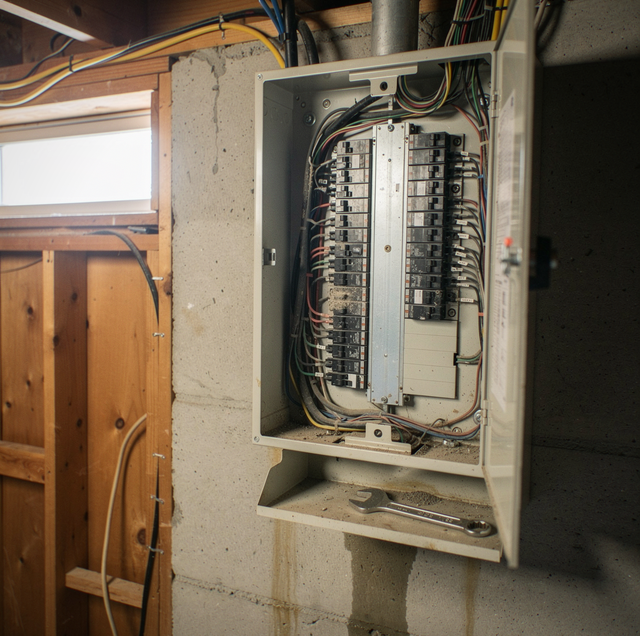
The dead front, the cover plate over the breakers, hides most of what actually determines a panel's condition. Behind it: the bus bar the breakers clip onto, the neutral and ground connections, and signs of heat damage that never show from outside. An electrician removes that cover and looks for discoloration around specific breakers (a sign of a loose connection arcing under load), corrosion on the bus bar (common in coastal or damp basements), and breakers that are double-tapped, meaning two circuit wires land under a single breaker's lug when that breaker was only designed to hold one. Double-tapping occurs when a room gets an additional circuit, and the easiest slot to land it on is already occupied. It works mechanically, but the connection point wasn't engineered to clamp two conductors evenly, so one of them is often loose enough to arc under normal use.
None of this shows up from outside the panel. A visual scan sees a cover that looks fine. Opening it is the only way to know what's actually happening at the connections.
Panel brand matters here too. A small number of panel lines manufactured mostly in the 1960s through the 1980s are known for breakers that fail to trip under an overload, a defect tied to the breaker's internal mechanism rather than to age or wear. These panels are still found in older homes across the country, and spotting the brand on the panel label is one of the fastest, highest-value findings an inspection can turn up, because the recommendation in that case usually calls for full replacement rather than repairing individual connections.
| Signal during a walkthrough | What it usually means |
|---|---|
| Panel cover has extra breakers snapped in, more than the slots the panel was designed for | Tandem or double-tapped breakers added after the original install, sometimes beyond what the panel is rated to carry |
| Outlets throughout the house are the older two-slot type, with no third round hole | No grounding conductor at those outlets, common in wiring from before the 1960s |
| A cloth-wrapped or fabric-sheathed cable is visible in the attic or basement | Likely knob-and-tube or early rubber-insulated wiring, both well past their expected service life |
| The panel brand is unfamiliar, or the breakers look mismatched from row to row | Possible obsolete panel type or breakers swapped from a different manufacturer, a known fire-risk combination in a few discontinued panel lines |
| A room or addition runs on an extension cord snaking through a wall or under a door | Circuit never properly extended into that space, a workaround rather than a wired solution |
What Two-Prong Outlets Signal About the Whole House
A two-prong outlet by itself is a minor inconvenience: no ground pin means some modern plugs (and their built-in surge protection) won't seat properly. The bigger signal is what it says about everything behind the wall. Grounding became standard residential practice broadly in the 1960s, so a house still running on two-prong outlets throughout usually has the original ungrounded wiring behind every wall, not just at the outlets you can see. That matters for anything you plan to plug in that expects a ground path: computers, many kitchen appliances, and most surge protection strips rely on it to work correctly.
An inspection checks a sample of these outlets with a simple tester, but the more informative step is opening one or two switch boxes and outlet boxes to see the conductor type and insulation directly, since that tells an electrician whether the fix is outlet-by-outlet or a whole-circuit rewire.
Reading What's in the Attic and Basement
Knob-and-tube wiring, identifiable by ceramic knobs anchoring the wire to framing and ceramic tubes protecting it where it passes through joists, was standard practice through the 1930s and 1940s and shows up regularly in houses from that era that haven't had a full rewire. It isn't automatically dangerous by design, but it was engineered for a much lighter electrical load than modern homes carry, has no ground conductor, and its rubber-based insulation turns brittle and cracks with decades of heat cycling. Insurance carriers frequently flag it during underwriting for exactly that reason.
Aluminum branch wiring, common in a narrower window mostly through the 1960s and into the early 1970s, brings a different mechanism into play: aluminum expands and contracts with temperature more than copper, which loosens connections at outlets and switches over years of use, and aluminum also develops a thin oxide layer at those loosened points that resists current flow and generates heat. An inspector traces visible sections in the attic and basement, checks the connection points at a sample of switches and outlets for telltale signs (warm cover plates, slight discoloration, an aluminum sheen), and flags whether the issue appears throughout or only in isolated circuits.
What a Pre-Purchase Electrical Inspection Actually Delivers
| Deliverable | What it tells you |
|---|---|
| Panel condition report | Bus bar and breaker condition, double-tapped circuits, panel brand/model flags |
| Wiring type map | Where knob-and-tube, aluminum, or ungrounded circuits still run |
| Outlet and switch sample testing | Grounding status, reverse polarity, GFCI presence where it's expected |
| Circuit load notes | Whether the panel has room for planned additions (a heat pump, an EV charger, a remodel) |
| Priority list | Which findings are urgent safety items versus items that can be planned for later |
That priority list is often the most useful part for a buyer working within a closing timeline. Not every finding demands immediate correction. A double-tapped breaker feeding a garage light fixture is a different priority than the same condition on a breaker feeding a kitchen circuit with several appliances. An inspection that separates "fix before move-in" from "plan for within the next few years" gives a buyer something to negotiate with or budget around, rather than a flat list of problems with no ranking.
The report format itself varies by inspector, but a useful one reads more like a punch list than a narrative: each finding tied to a specific location in the house, a plain description of what was found, and a rough sense of urgency. A buyer can hand that directly to a seller's agent during negotiation, or keep it as a working document for the first year or two of ownership if the deal closes without renegotiating repairs.
Older Coastal Homes Carry a Few Patterns of Their Own
Age isn't the only variable. Homes near a coastline or with heavy marine-layer exposure show accelerated corrosion on outdoor panels, disconnects, and exterior fixtures, regardless of the wiring's actual age, because salt-laden moisture attacks exposed metal and gaskets faster than in a dry inland climate. An inspection of an older coastal property checks the outdoor panel enclosure and any exterior disconnects specifically for that pattern, since a panel that looks presentable from a few feet away can have a bus bar showing early corrosion once the cover comes off. Many older homes in seismic regions also carry panels that were never properly secured to framing during a past remodel, which an inspection checks alongside the electrical findings even though it's a mounting issue rather than a wiring one.
Buying a home is one of the few purchases where the parts you can't see decide as much as the parts you can. A roof or a foundation crack announces itself. A double-tapped breaker or a run of brittle knob-and-tube insulation sits quietly behind a wall until the day it doesn't. An electrical inspection before closing turns that guesswork into a specific, prioritized list, which is worth having whether the house is a century old or simply older than its current owner realizes.
Frequently Asked Questions
A focused electrical inspection typically runs one to two hours on its own, versus the fifteen or twenty minutes the electrical portion gets inside a multi-system general walkthrough, because it involves removing the panel cover, tracing sample circuits, and opening a handful of outlet and switch boxes rather than a visual pass. Scheduling it as a separate visit, timed after the general inspection flags a concern, is common, and a larger or older home with more wiring types to trace can push that window longer.
The inspection itself reports condition and wiring type, not insurance policy language, but the findings (particularly knob-and-tube presence or an obsolete panel brand) are the same details underwriters ask about, so a buyer can bring the report directly into that conversation with an insurer or agent.
Some jurisdictions and insurers allow it to remain in sections that aren't covered by insulation and aren't overloaded, since the insulation-contact issue is what causes the wiring to overheat. An inspection identifies exactly where it runs and whether it's buried under attic insulation, which is the detail that usually decides whether it stays or gets replaced.
A focused electrical inspection typically notes whether detectors are present and whether they appear to be on a dedicated circuit or battery-only, since that affects how a buyer plans follow-up work, even though detector placement itself falls more under fire-safety guidance than electrical code.
A panel with sound bus bars and a correctly rated breaker count often just needs a handful of connections corrected (a double-tapped breaker split properly, a corroded lug cleaned or replaced). A panel showing bus bar damage, an obsolete or recalled breaker line, or physical heat damage inside the enclosure usually points toward full replacement rather than a repair, and an inspection is what tells you which situation you're in.
Many buyers schedule it during the standard inspection contingency window after an offer is accepted, since that's when there's contractual room to renegotiate or request repairs based on the findings. Waiting until after closing removes that negotiating position entirely, since the findings become the new owner's problem to fund rather than a point of discussion with the seller.
Schedule a pre-purchase electrical inspection — get a panel-opened, wiring-traced report before your contingency window closes. Ridgeline Electric serves Santa Cruz and the surrounding area. Call (831) 206-5602.
