
Hot Tub Dedicated Circuit: What Your Wiring Really Needs
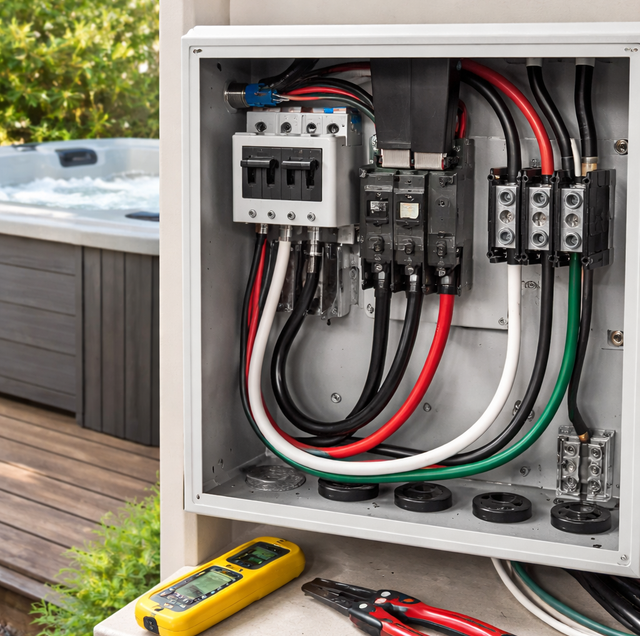
Quick Answer: A small 120V plug-in spa can often run from a properly protected outlet, though ideally its own. A larger 240V hot tub almost always needs its own dedicated circuit, sized to the unit, protected by a GFCI, and fitted with a disconnect nearby. A licensed electrician should confirm your panel can carry the load and do the wiring.
Buying a hot tub is exciting right up until the delivery crew asks where the power is coming from. That single question decides whether you plug in and soak the same evening or wait a week for wiring work. The short version: it depends entirely on the type of spa you bought, and the difference between a plug-in model and a hardwired one is not a small detail. It changes what your electrical panel has to do, how the tub is protected, and whether the setup is safe to sit in.
What "Dedicated Circuit" Actually Means
Every circuit in your home is a loop of wire that starts at a breaker in your panel, runs out to outlets or fixtures, and returns. That breaker is sized to a limit, usually 15 or 20 amps for general household circuits. Everything sharing that loop draws from the same budget. Plug in a vacuum, a space heater, and a hair dryer on one circuit, and you trip the breaker because their combined draw exceeds what the wire and breaker are rated to carry.
A dedicated circuit serves one appliance and nothing else. It runs its own wire from its own breaker straight to that single load. Your kitchen range, your electric dryer, and your central air already work this way, because each pulls far more current than a shared outlet could handle without overheating.
A hot tub sits in that same heavy-draw category. The heater alone can pull thousands of watts, and it runs alongside circulation pumps, jet pumps, and controls that all draw at once when the tub fires up to hold temperature. That is a sustained, high-current load, not a quick spike. It needs a wire and breaker sized specifically for it, with no other appliance competing for the same capacity.
Plug-In 120V Spas Versus Hardwired 240V Hot Tubs
The line that separates "plug it in" from "call an electrician" is voltage and current draw.
The 120V plug-in spa: These are the smaller, often inflatable or roll-away models sold as convertible or plug-and-play units. They run on a standard 120-volt supply and typically draw around 12 to 15 amps. Because the heater and pump are limited to that lower ceiling, the water heats slowly, and the heater usually cannot run at the same time as the jets on high. The manufacturer designs the unit to stay within a standard outlet's budget.
Even so, a plug-in spa should have its own receptacle. If it shares a circuit with a garage freezer, exterior lights, or an outdoor outlet someone runs a leaf blower from, the combined load will trip the breaker or, worse, quietly overheat the wiring over time. Many of these units also ship with a GFCI built into their cord, which is the shock protection that makes near-water use survivable. That cord protection is not a license to daisy-chain the tub onto a busy circuit.
The 240V hardwired hot tub: Full-size acrylic hot tubs, the kind set into a deck or patio, run on 240 volts and are hardwired. Depending on the model, they draw anywhere from 40 to 60 amps, with 50 amps being common. There is no plug. The wiring runs from a dedicated double-pole breaker in your panel, out to a nearby disconnect, and into the tub's control pack. This is the type that always requires a dedicated circuit, and it is the type this article is really about.
Why Sharing a Circuit or Using a Cord Fails
Water and electricity together are lethal, so the failure modes here are not merely inconvenient. They are the reason the rules exist.
Overheating: A 50-amp hot tub asks for a steady flow of current for as long as it holds temperature. Force that through a wire sized for a general 15-amp circuit and the wire heats up. Heat degrades insulation, loosens connections, and eventually chars terminals inside outlets and junction boxes. This is a slow-building fire risk that shows no obvious warning until something scorches or smells hot.
Tripping: A shared circuit trips the moment the tub's heater and pump draw combine with whatever else is on the line. A tripped breaker mid-cycle is a nuisance, but the deeper problem is what people do about it: they swap in a bigger breaker to stop the trips. That defeats the one device protecting the undersized wire from overheating, and now the fire risk is real with no safety net.
Shock: An extension cord is the worst offender. It adds length, which drops voltage and raises current draw, and it introduces connection points that corrode and loosen outdoors. A cord lying in a wet deck environment near a tub full of water and bathers is exactly the scenario ground-fault protection is meant to prevent. Never run a hot tub of any size on an extension cord.
Consider a garden hose here. A short, wide hose delivers strong flow, but attach a long, thin hose and the pressure at the far end drops to a trickle while the pump strains. Undersized wire behaves the same way with electricity, except the "strain" shows up as heat inside your walls instead of a weak sprinkler.
What a Correct 240V Hot Tub Install Includes
A proper hardwired installation has several required parts, and each one does a specific safety job.
A dedicated circuit sized to the nameplate: Every hot tub carries a data plate listing its voltage, current draw, and the minimum circuit and breaker size the manufacturer specifies. The electrician wires to that plate, not to a guess. A 50-amp tub gets a 50-amp double-pole breaker and correspondingly sized copper conductors. Undersizing overheats the wire; oversizing the breaker removes protection. The nameplate is the source of truth.
GFCI protection: Ground-fault protection watches the current going out and coming back. If even a tiny amount leaks, say through a person or through water reaching a live part, the imbalance trips the circuit in a fraction of a second. Because a hot tub combines water, metal, and people, GFCI protection is mandatory, typically delivered through a GFCI breaker or a GFCI-equipped disconnect. It is the single feature most responsible for making an energized tub survivable to sit in.
An accessible disconnect near the tub: Code requires a means to cut power that is within sight of the tub but set back a safe distance from the water, so no one has to lean over the tub or run to the main panel in an emergency. This disconnect lets a service tech kill power before working on the pump, and lets anyone shut the tub off fast if something goes wrong.
Bonding of the metal parts: Bonding ties all the tub's metal components, the pump housing, heater, metal jets, ladders, and any nearby metal, together with a heavy copper conductor, often through a bonding lug on the equipment pad. The goal is to keep every metal surface at the same electrical potential so a fault cannot create a voltage difference that a wet bather bridges. Bonding is separate from grounding and is frequently the step DIY attempts skip entirely.
Your Panel Has to Have Room
Adding a 50-amp circuit assumes your electrical panel can spare 50 amps. Many cannot, especially older homes already running an EV charger, an electric range, and air conditioning. A licensed electrician performs a load calculation, adding up your home's existing demand against your service size, to confirm the panel can carry the new tub without exceeding its rating. If it cannot, the fix is a panel or service upgrade before the tub gets wired, not a shortcut around the math. Skipping this step is how a whole home ends up with an overloaded service that trips repeatedly or runs hot at the main.
Because bonding, GFCI protection, load calculations, and disconnect placement all have to be right, and because getting them wrong near water can kill someone, hot tub wiring is licensed-electrician work. It is not a weekend project, and it is not something to hand to a handyman with a spare breaker.
Water and electricity together are lethal, so never run a hot tub of any size on an extension cord, and never swap in a bigger breaker to stop nuisance trips, since that removes the one device protecting the wire from overheating. Because bonding, GFCI protection, load calculations, and disconnect placement all have to be right, hot tub wiring is licensed-electrician work.
Frequently Asked Questions
No. A pool pump already occupies that dedicated circuit at close to its rated capacity, and pool equipment circuits are sized and bonded for the pool, not for a spa's heater load. Even where a tub sits beside a pool, it gets its own home run from the panel. The one exception is a factory pool-spa combination unit engineered and listed to share equipment, in which case you follow that unit's data plate rather than improvising.
Yes, and the two are not interchangeable. A main GFCI, where one exists, protects at a whole-panel level and would shut down your entire house on a fault, which is impractical and often causes nuisance trips. The hot tub needs its own dedicated GFCI device on its own circuit so a leak at the tub trips only the tub. Most homes have a standard main breaker with no GFCI at all, which is exactly why the tub circuit must supply its own.
The disconnect must be readily accessible and within sight of the tub, yet set back at least five feet from the inside wall of the tub, so a person in the water cannot reach it and no one operates it while touching the water. It also cannot be mounted behind the tub where it becomes unreachable. Placement is a common failure point that inspectors flag even when the wiring itself is correct.
It can, if that subpanel has the spare capacity and the feeder to it is sized for the added load. A detached structure introduces its own grounding and bonding requirements at the subpanel that a main-panel install does not, so the electrician evaluates the feeder, the grounding electrode setup, and available amperage before committing. A subpanel already loaded with shop tools rarely has room without an upgrade.
Yes, and it works in both directions. In cold months, the heater runs longer and more often to fight heat loss to the air, so the circuit sees sustained draw for longer stretches. In warm months, the heater cycles far less, but the pump and the freeze-protection routine still draw. This is one more reason the circuit is sized to the tub's full nameplate rating rather than to how much power you assume it will use on a mild day.
For a 50-amp hardwired tub, the conductors are commonly 6-gauge copper for the hot legs, with an appropriately sized neutral and ground per the unit's requirements, run inside conduit or as approved cable for a wet, outdoor location. The exact gauge depends on the breaker size, the distance from the panel, and whether voltage drop over a long run forces an upsize. An electrician calculates this rather than defaulting to a generic chart.
Have an electrician size and wire your spa circuit right the first time — safe soaking starts with correct power. Ridgeline Electric serves Santa Cruz and the surrounding area. Call (831) 206-5602.
