
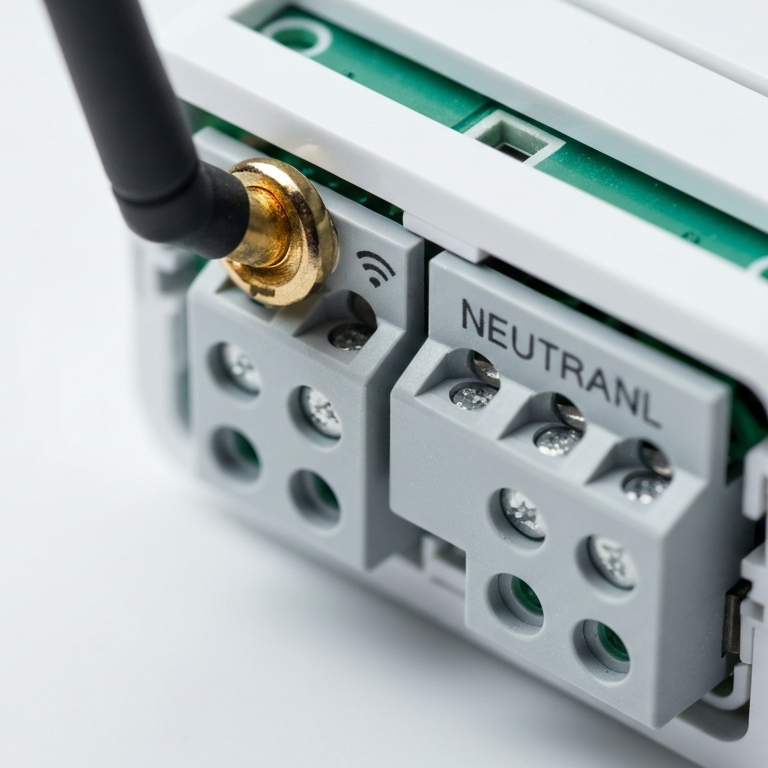
You bought a smart switch on Sunday. By Monday night, you have pulled the old switch out of the wall, you're standing in the hallway with a flashlight, and you have no idea which wire is which. Black. Maybe another black. Maybe a white. Maybe a bundle of whites stuffed behind the box with a wire nut on top. The instructions want a neutral.
You don't know if you have one.
This is the most common reason a smart switch project stalls. The technology has changed faster than the wiring in most houses, and what makes sense electrically in a switch box from 2020 doesn't necessarily exist in a switch box from 1968.
Here's why smart switches need a neutral, how to tell if your boxes have one, and what to do when they don't.
Why a Smart Switch Needs a Neutral
A regular toggle switch is mechanical. It physically breaks the hot wire to turn the light off, and it doesn't need any power of its own to do that. When the switch is off, no current flows through it. Period.
But a smart switch is different. It has a radio inside — Wi-Fi, Zigbee, Z-Wave, Thread, Matter, Bluetooth, take your pick — and that radio has to stay awake even when the light is off. Otherwise you couldn't turn the light back on from your phone.
So the radio needs a small, steady supply of power. The only way to give it that power cleanly is to give the switch a complete circuit it can sip from. That circuit needs both a hot and a neutral wire at the switch. With a neutral, the switch's internal power supply runs all day at a few milliamps without affecting the light at all. Without one, the switch has to find another way to power itself — and that "other way" is exactly what limits which switches work in older homes.
How to Tell If Your Switch Box Has a Neutral
You can answer this question in two minutes with the breaker off and the cover plate off.
Step 1. Find the breaker that powers the switch and turn it off. Verify with a non-contact tester that the switch is dead.
Step 2. Remove the cover plate and the two screws holding the switch in the wall. Pull the switch out of the box gently — don't disconnect any wires yet.
Step 3. Look at what's in the box.
| What you see in the box | What it usually means |
|---|---|
| Two black wires landed on the switch, and no white wires anywhere | No neutral in the box (typical of older homes) |
| Two black wires landed on the switch, plus a bundle of white wires twisted together behind the box | Neutral is available — usually one of the whites can be tapped for a smart switch |
| Two black wires on the switch plus a white wire used as a "switch leg" (often marked with black tape) | Older convention: the white is being used as a hot, not as a neutral |
| Two black wires landed on the switch, and a white wire already going to the switch terminal | Some recent smart switches and a few modern dumb switches already have the neutral connected — confirm by reading what's on it |
| A red wire in addition to the black and white | Three-way or four-way circuit; smart switch wiring gets more involved |
The bundle of whites in the box is the easy tell. Those whites are the neutral conductors for the circuit, and modern switch boxes are required to keep that bundle accessible inside the box, even if the dumb switch never used it. Homes built or rewired since the mid-1980s usually have neutrals in every switch box. Homes wired before that often don't.
What If You Don't Have a Neutral
No neutral? You have three real options.
Option 1: Use a Smart Switch Designed to Work Without a Neutral
A few smart switch lines work without a neutral. The most popular is Lutron Caséta, which has been built around no-neutral installs since the product line launched. The Caséta switch passes a tiny leakage current through the light to keep itself powered. The light's small response is what keeps the switch's radio alive.
A few caveats apply.
The light fixture has to tolerate the tiny standby current without flickering, glowing faintly, or buzzing. Most modern LED bulbs and most older incandescent bulbs handle it fine. Some older or budget LED bulbs don't. Lutron publishes a compatibility list — use it.
The minimum load matters. A no-neutral switch needs at least a small bulb on the circuit to function. One LED bulb on a fixture that gets used rarely sometimes isn't enough load.
Some no-neutral lines use their own hub. Lutron Caséta uses a Lutron Smart Bridge that talks to the switches over Lutron's own radio (Clear Connect), then talks to your home network over Wi-Fi. Other no-neutral lines work with standard Zigbee or Matter hubs.
This is the cleanest fix for older homes. Buy the right switch. Wire it the same way the old dumb switch was wired. Done in twenty minutes.
Option 2: Have an Electrician Pull a Neutral Into the Box
If you want a Wi-Fi smart switch that requires a neutral — and there are far more options in that category — you can have an electrician run a neutral conductor into the box.
What this involves:
Identifying which circuit feeds the switch box and tracing where the neutral for that circuit is closest. Sometimes that's in a junction box in the ceiling above. Sometimes, a nearby outlet. Sometimes back at the panel.
Pulling a new conductor from that point to the switch box. In an open attic or accessible crawlspace, this is a half-day job. In a finished two-story home with insulated walls, it's much more involved and may need drywall patching.
Relanding the conductors so the switch box has hot, neutral, switch-leg, and ground all on screw terminals.
The cost depends entirely on how accessible the wiring path is. A switch box right under an open attic with a clear conductor run is fast. A box in the middle of a finished interior wall with no nearby fishing point is the expensive case.
Option 3: Make the Light Smart Instead of the Switch
If retrofitting a neutral is too disruptive, go the other direction. The bulb-side approach is often the right answer. A smart bulb has the radio and power supply built in, and it works with any switch — even a 50-year-old toggle. You leave the dumb switch in the wall, set it permanently to the "on" position, and control the bulb from your phone or a separate scene controller.
This trades one limitation for another. The dumb wall switch still works mechanically, which means a houseguest can hit it, and the bulb loses power and goes offline. Some people solve this by replacing the dumb switch with a no-load wall remote that communicates directly with the bulb. That puts a button back on the wall and avoids the "guest cuts power, and the lights go dumb" problem.
| Approach | Neutral required at box | Best for |
|---|---|---|
| Neutral-required Wi-Fi/Zigbee/Z-Wave smart switch | Yes | Newer homes; any wall switch in a box with a neutral bundle |
| No-neutral smart switch (Lutron Caséta and others) | No | Older homes with switch-loop wiring |
| Pull a neutral into the box | Yes (will be installed) | Open walls, accessible attics, or whole-house smart-home upgrades |
| Smart bulbs with a dumb switch left in place | No | Renters, single-bulb fixtures, low budgets |
Three-Way and Four-Way Circuits
Smart switches in three-way (two switches controlling one light) and four-way (three or more switches controlling one light) circuits add a wrinkle. The "second" or "third" switch in the chain often needs to be a special add-on or companion switch — not a second standard smart switch. The main smart switch is at one location and includes the radio and the relay, while the companion switches communicate with it via a low-voltage signal or the home's wireless network.
Got a three-way circuit? Look at both switch boxes before you buy anything. Both ends need to have what the smart switch system expects — often a neutral at the main location and a traveler wire between the two boxes. If either box is missing what you need, the project won't work the way you want.
Frequently Asked Questions
No. Don't. Ground and neutral are not interchangeable, even though they end up tied together back at the main panel. Using the ground as a return path places current on the ground wire where it shouldn't be, which can create a shock hazard, trip GFCIs and AFCIs, and damage equipment. Either use a no-neutral switch, pull a real neutral, or go the smart-bulb route.
Homes built or rewired since the mid-1980s usually have neutrals in every switch box. The rules began requiring it in many switch-loop configurations in 2011 to make exactly this kind of smart-switch retrofit possible. Older homes are a mixed bag — some boxes have neutrals (because the wiring happened to run through that box) and some don't. The only way to know for sure is to take the cover off and look.
Most modern LEDs work fine. A few don't. Symptoms of an incompatible bulb are faint glow when the switch is off, slow buzz, or flickering at low dim levels. The manufacturer of the no-neutral switch usually publishes a compatibility list. If you're seeing problems, swapping the bulb to one on the list is usually faster than swapping the switch.
Metal boxes are fine for smart switches. The box itself has to stay grounded, and the smart switch has to be grounded just like a dumb switch would. Some smart switches are slightly larger than the switches they replace — confirm the switch will fit in the box's wire-fill capacity before buying.
Check the lease first. Many landlords are fine with it as long as the original switch is reinstalled at move-out. If swapping the switch isn't allowed, the smart-bulb-plus-wall-remote approach is fully reversible and usually doesn't need any landlord approval.
Most do, for the same reason a regular smart switch does — the radio has to be powered. A few dimmer lines (again, Lutron Caséta is the most common) are built specifically to work without a neutral. If you want a dimmer smart switch in an older home, the no-neutral product lines are the right place to start.
Look Before You Buy
The single move that prevents most smart switch project headaches is taking the cover off one box before you click "add to cart." Sixty seconds of looking tells you which territory you're in — neutral-available (any smart switch on the market) or no-neutral (Lutron Caséta or similar). Five minutes of looking across the house tells you if the boxes you want to make smart all match, or if a few rooms are going to need a different approach. That little bit of homework up front is the difference between a twenty-minute install and a return trip to the store.
