Your phone goes off at 9:14 on a Tuesday night. Three tenants in three different units have texted in the last hour. The lights are flickering. The TV picture rolls. An LED bulb in 2A buzzed and died.
The wave of complaints is the part you can't ignore. But it's also the part that tells you what's wrong — if you read it carefully.
Single-unit flicker usually traces to something inside that apartment: a loose neutral at one device, a dimmer fighting an LED bulb, an appliance kicking on a shared circuit. Multi-unit flicker is a different animal. When two or more apartments flicker at the same moment, the fault has to be somewhere they share — the main panel, the feeders running to each unit's subpanel, or the utility service feeding the whole building. The list is short. That's what makes diagnosis fast, if you call the right kind of electrician with the right kind of information.
Read the Pattern Before You Make the Call
The pattern of the flicker is the single most useful data point you can give the electrician. The five patterns below cover almost every multi-unit call. Quick reference in the table; prose underneath has the depth.
| What you're seeing | Likely cause | Urgency |
|---|---|---|
| Lights brighten in some units while dimming in others, shifting as appliances cycle | Failing service neutral at the meter base, main lug, or utility splice | Emergency — same-day call |
| Lights dim across multiple units when a large appliance starts, then recover | Service running close to its capacity at peak demand | Plan a service upgrade or load-management retrofit |
| Voltage sags don't correlate with building load (happen when the building is quiet too) | Problem on the utility side of the meter (transformer, service drop, splice) | Document with logged data and report to the utility |
| Flicker is intermittent and affects only units served by one feeder | Loose connection on a feeder lug inside the building | Schedule a thermal scan; repair the connection |
| Flicker is only in one unit and only when that unit's appliances cycle | Unit-level problem (loose neutral in the unit panel, backstabbed receptacle, failing dimmer) | Treat as a single-unit service call |
Lights brighten in some units while dimming in others, often shifting as appliances cycle. This is the failing service neutral, and it's the one you treat as an emergency. The neutral conductor returning current to the utility transformer has loosened or corroded at the meter base, the main lug, or the utility splice. With a bad neutral, the voltage on the two hot legs is no longer held at 120 volts each — one rises while the other falls. You see see-saw brightness across units fed from opposite legs. What you don't see is the overvoltage damage to electronics, motors, and LED drivers throughout the building. And a neutral lug that can run hot enough to ignite nearby insulation. Call an electrician the same day. Don't wait for the weekend.
Lights dim across multiple units the moment a large appliance starts, then recover. This is the building's service running close to its capacity. Window AC units, EV chargers, induction cooktops, and electric dryers got added to a building originally sized for the load profile of a different decade. Every time the HVAC compressor on the roof or a tenant's dryer in 3B kicks on, the voltage at the panel sags briefly. Not an immediate fire hazard. But it gets worse as tenants keep adding load, and at some point, the main breaker starts nuisance-tripping.
Voltage sags don't track building load — they happen when the building is quiet, too. This one usually means the problem is on the utility side of the meter. A weathered splice on the overhead service drop, a loose connection at the transformer, or a transformer that's undersized for the loads it now serves can all produce voltage swings the building owner has no authority to fix. The utility will dispatch a crew to inspect when there's logged data showing the issue is theirs.
Flicker is intermittent and affects only the units served by one feeder. This points to a loose connection inside the building — typically a feeder lug at the main panel, at a junction box on the feeder run, or at the unit subpanel. The connection produces enough heat to damage the panel parts long before anyone sees a flame. An infrared scan under load shows the hot spot before it's visible to the eye.
Flicker is only in one unit and only when that unit's appliances cycle. That's not a multi-unit problem at all. It's a unit-level issue with a loose neutral inside the tenant's panel, a backstabbed receptacle on the affected circuit, or a failing dimmer. Treat it as a single-unit call and don't spend money diagnosing the rest of the building.
What an Electrician Actually Does on the Visit
Multi-unit flicker gets investigated from the top of the system down. Every upstream component is shared by more units, so a problem at the top affects everything below it. A first visit looks roughly like this.
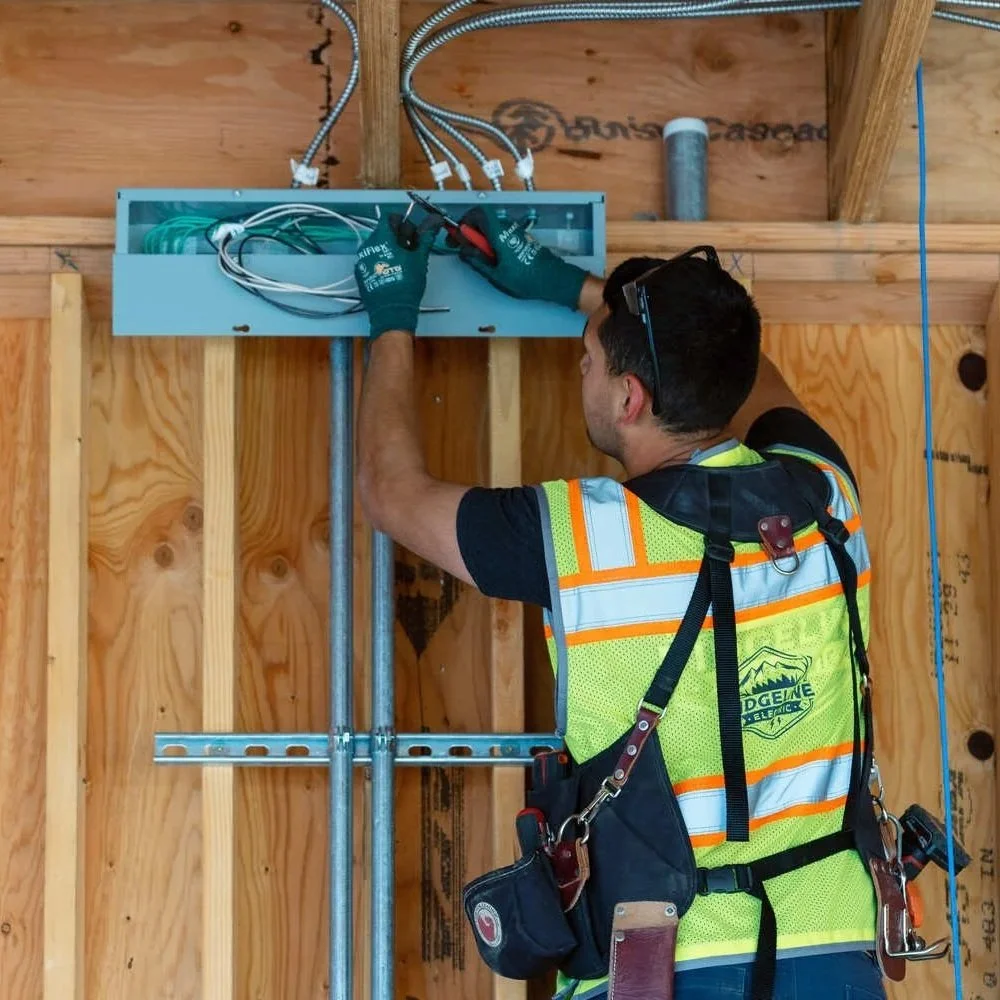
The recording voltmeter goes on the main panel first. It stays there long enough to catch a peak-demand cycle — usually a hot weekday evening. While it's logging, the electrician opens the main service entrance and the meter base for a visual inspection. Scorching on the neutral lug, a discolored neutral conductor, or a hot meter base will tell the same story the voltmeter tells in writing. If the visible signs are there, the conversation shifts to emergency scheduling on the spot.
Next comes the feeder walk. From the main panel out to each unit subpanel, the electrician identifies any junction boxes, tap boxes, or feeder splices and checks each one. Thermographic imaging of the panels under load picks up hot connections that don't show up to the eye. Each hot spot gets a photo and a temperature reading.
If the voltage logging shows variations that don't correlate with building load, the conclusion is usually that the fault is on the utility side. The electrician's job at that point is to produce data — voltmeter logs, time stamps, weather — that the utility's crew can act on.
What you get is a one- or two-page report identifying the cause, the recommended repair sequence, and the urgency. You use it to schedule the work, justify the expense to ownership, and brief tenants.
What to Document Before You Call
The diagnosis goes faster — and costs less — when you arrive at the appointment with answers to five questions already written down.
Which units are reporting the flicker? Apartment numbers, floors, and the side of the building.
When does it happen? Time of day, day of week, and whether it correlates with any specific appliance or shared system (HVAC, elevator, laundry room).
Has any tenant equipment failed? Dead electronics, burnt-out LED drivers, motor failures — the kind of damage that points specifically to a failing neutral.
Has the main breaker tripped recently? A tripped main is a strong signal that the building is running at its service capacity.
Has the utility done any recent work nearby? A planned outage, a transformer swap, or a service-drop reconnection in the past few weeks can point straight at the cause.
What the Repair Looks Like
Each pattern above has a repair scope, and the scopes don't overlap much.
A failing service neutral usually means the utility retorques or replaces the splice at the transformer or service drop on its side of the meter, and the electrician replaces or repairs the meter base, main lug, or service-entrance conductors on the building side. Coordination between the two is part of the job.
A capacity-overloaded service is fixed with a service upgrade — larger service-entrance conductors, larger main breaker or switchgear, sometimes a new meter section. If that's not an option in the near term, load-management controls on the largest discretionary loads (EV chargers being the main one) can throttle the building back during peak hours.
A utility-side problem gets diagnosed inside the building with logged data, but the repair itself belongs to the utility. Your job is to produce the data. Theirs is to dispatch a crew and do the work.
A loose feeder or panel connection is repaired by de-energizing the panel, cleaning and retorquing the connection to spec, cutting back any damaged conductor, and re-scanning a day or two later under load to confirm the repair held.
Frequently Asked Questions
The see-saw pattern — some units brightening while others dim, especially when it shifts as appliances cycle — is the emergency. Capacity-driven dimming when a large appliance starts is less urgent but still needs to be addressed before it gets worse. A licensed electrician can confirm which pattern is present with logging equipment in a single visit.
You can collect everything that makes the diagnosis faster — which units, what time, what appliances were running. The actual measurement and repair need a licensed electrician with a recording voltmeter, a clamp meter, and a thermal camera. The faster you arrive at the appointment with documented symptoms, the cheaper the visit.
When the flicker is inside one unit and only happens when that unit's appliances start, it's a unit-level problem — usually a loose neutral inside that unit's panel, a backstabbed connection, or a failing dimmer. When two or more units flicker at the same moment, the fault is in shared building equipment, which is the owner's responsibility. Usually obvious once the symptoms are catalogued.
Two to four hours on site, plus the time the logging equipment sits in place to capture a peak cycle. The visit covers visual inspection of the main equipment, voltage and current readings, and a walk of the feeders to the unit subpanels. A thermal scan adds another hour.
Most utilities will dispatch a crew at no cost to investigate a reported voltage problem at the service. The investigation goes faster when you have logged voltage data to show them. Faster still when a licensed electrician has already ruled out the building side.
Yes — in two passes. A brief notice early that the issue is being investigated keeps tenants from feeling ignored. A follow-up once the diagnosis is in and the repair is scheduled (including any short outages they should expect) keeps the relationship clean.
Don't Replace Light Fixtures Until You Know the Cause
Multi-unit flicker is one of the few electrical issues where the wrong diagnosis costs more than the right one. Rewiring units or swapping fixtures does nothing if the actual fault is a loose neutral at the meter base or an overloaded service. Investigate from the top down. Capture voltage and current data under realistic load. Inspect the visible signs on the main equipment. Only then look at unit-level work. Once the upstream fault is identified and repaired, the flicker stops — and the building's electrical system is back in a stable, documented condition that protects tenant equipment and ownership's investment.
