
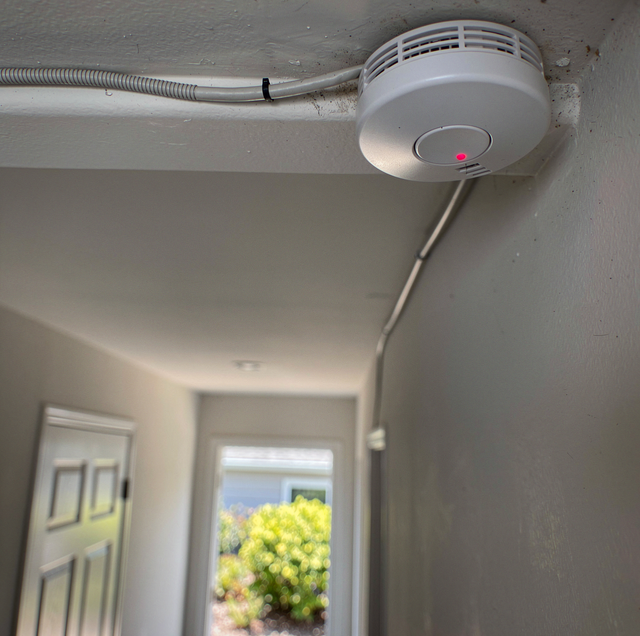
One alarm sounding in a basement wakes whoever happens to be there. Every alarm in the house sounding at the same instant wakes the person asleep two floors up behind a closed bedroom door. Hardwiring buys the second version. The power feed is one part of that, and the connection running between the units is what turns a single sensor into a whole-house signal.
Quick Answer: Hardwired alarms run on house power with a backup battery, and they are usually linked to each other, so when one senses smoke or carbon monoxide, every alarm in the house sounds. That linkage is what buys time to get out.
Why the Alarm Nearest the Fire Is Rarely the One That Matters
Fires start where nobody is standing. A failing power strip behind a couch in a finished basement, lint packed into a dryer duct, an extension cord under a workbench in the garage. The alarm closest to that spot sees smoke first, and it is usually the alarm farthest from the people who need to move.
Smoke does not fill a house evenly. It rises off the fire, spreads across the ceiling in a layer, and travels along hallways and up stairwells, cooling and thinning as it goes. Minutes pass before enough of it reaches a bedroom on an upper floor to trip the unit mounted up there. Those minutes are the escape window, and they are spent while a horn sounds in an empty basement.
Sound runs into the same walls. A closed bedroom door slows fire and smoke, which is exactly why it is worth closing at night, and that same door muffles a horn two floors below. Deep sleep raises the bar again. Children in particular are hard to wake with noise alone.
Interconnection takes distance out of the equation. Wired alarms share a third conductor alongside the two that carry power. When one unit's sensor trips, it places a signal on that conductor, and every other unit on the loop sounds its own horn on its own power. Detection happens in the basement. The noise occurs in the bedroom at full volume on the near side of the closed door.
What the Hardwired Supply Adds
A hardwired alarm sits on a household branch circuit and draws a small standby current around the clock. It never has to ration power, its horn has the full supply behind it when it sounds, and nobody has to remember to feed it every year. A battery-only alarm spends its whole service life drawing down the very cell it depends on, and it carries no wire to tell any other alarm what it has found.
House power is also the thing most likely to disappear during the event the alarm exists for. Storm outages take the circuit down. A breaker trips. A fire inside a wall cavity can compromise the branch circuit feeding the alarms before smoke reaches any sensing chamber. The backup battery covers that gap, which is why it is built into the design. A hardwired alarm with a dead backup cell stops protecting the house at the exact moment conditions turn worst.
The backup keeps the interconnection alive too. Running on battery during an outage, a linked system still passes the signal from unit to unit, so the whole-house response survives the loss of power.
There is one check worth doing that requires nothing more than a finger, and the usual cadence is once a month. Press and hold the test button on a single alarm. In a working interconnected system, every other alarm in the house should sound within a few seconds. If the one you pressed is the only thing making noise, the units are powered but not talking to each other, and the house-wide behavior you assume you have is not there.
Two Sensors, Two Different Jobs
Smoke and carbon monoxide are caught by unrelated hardware. A smoke alarm monitors a small chamber for airborne combustion particles drifting in through slots in the housing. A carbon monoxide alarm holds an electrochemical cell, a sealed compartment with electrodes sitting in an electrolyte. Carbon monoxide diffusing into that cell oxidizes at one electrode, releasing a tiny current proportional to the amount of gas present. The unit monitors that current over time because exposure is a function of concentration and duration, which is why a CO alarm does not sound at the first trace of anything.
Both sensors age on their own schedule. An electrolyte depletes and dries out even if the cell never meets a gas molecule. A smoke chamber fouls with what floats through a house for a decade. The service lives that come out of that are different: smoke alarms are generally replaced at around ten years, and CO cells commonly carry a shorter rated life, printed by the manufacturer on the unit itself.
A combination alarm consolidates the housing, the power connection, the interconnect link, and the horn. It does not consolidate the sensors, their separate lifespans, or the placement logic each one wants. When either sensor in a combination unit reaches the end of its rated life, the entire device retires, because the two are not separately serviceable.
Carbon monoxide has no odor and no color, so the alarm is the only warning. If a CO alarm sounds, get everyone outside into fresh air first, then call emergency services from outside. Do not reset it or stay indoors searching.
Where Each Sensor Belongs
Smoke from a fire is hot and buoyant, climbs to the ceiling, and spreads outward in a layer. Smoke alarms mount high for that reason, on the ceiling or high on a wall, and clear of the pocket where wall meets ceiling, where air circulates poorly enough to delay the layer arriving. They also want distance from supply registers and open windows, where moving air can push smoke past a unit and around the chamber, and from the plume off a cooktop and the doorway of a bathroom, because steam droplets and cooking aerosols are particles the chamber cannot distinguish from smoke. An alarm that cries wolf every dinner is an alarm somebody eventually disables.
Carbon monoxide moves through a room on different terms. Its density is close enough to that of air that it neither collects at the ceiling nor pools on the floor; it drifts with whatever air currents the house already has and is distributed throughout the space. Height stops being the deciding factor. Nearness to sleeping people becomes it, because the dangerous window for CO is overnight, when nobody is awake to notice that anything has changed. Coverage gets organized around bedrooms, the hallways outside them, and each level of the house, rather than around the appliance most likely to make the gas.
That gap is where a combination unit accepts a compromise. One housing has to answer two placement logics at once, and the position that suits the smoke sensor is not always the position that best serves the CO cell. Plenty of houses run combination units happily. It is worth knowing which of the two sensors the mounting spot was chosen for.
The Date on the Back of the Unit
Every alarm carries a manufacture date stamped into the back or the side of the housing, where nobody looks. It is the single most useful piece of information on the device.
Sensors drift as they age. Over ten years, a smoke chamber collects household dust, cooking residue, and the occasional insect, and a fouled chamber can both fail to detect real smoke and react to nothing at all. A CO cell's chemistry runs down on the calendar. Neither failure announces itself. The test button confirms the horn and the electronics, not the sensitivity of the sensor behind them, so an alarm can pass every test you give it and still be past its useful life.
That is why there is a date on it at all. Replacement runs off the calendar rather than off behavior.
Sealed ten-year units carry a lithium cell sized to last through the sensor's rated life, with no battery door at all. Nothing to replace annually and nothing to forget; when the clock runs out, the whole unit goes. Replaceable-battery units let you swap the backup cell whenever it runs low, which keeps the alarm honest between now and its own retirement date.
The chirp is where the two failures get confused. A low-battery chirp usually settles once a fresh cell goes in. An end-of-life chirp comes from a timer inside the unit and keeps right on going with a brand-new battery in place, often on a different cadence. An alarm still chirping after a battery change is telling you the sensor itself has expired.
The manufacture date is printed on the back or the side of the housing, never on the face. Note it the next time you replace a backup battery, so you know which alarm in the house ages out first.
The Moments a House Gets Looked At Again
The question surfaces at particular moments, and the common ones are a permitted remodel, an addition, and a sale.
What is required varies by jurisdiction and by the kind of work: new construction, an addition, and a permitted remodel of an existing house are treated differently from one another. A licensed electrician confirms what applies at a specific address before work starts. What does not vary from one town to the next is the reasoning, which is everything above.
A remodel is the practical moment because the walls are open. Pulling an interconnect conductor between floors while framing is exposed adds very little to work already happening; doing the same thing later means opening finished surfaces to do it. Circuits are already being run and terminated.
An addition changes the house's geometry. A new bedroom is a new sleeping area, with new doors and a new distance between a sleeper and every existing horn. Alarms that covered the old floor plan may not cover the new one.
A sale brings an inspection, and the report lists alarms by location and by age, which is often the first time anyone in the household learns that half the units are past their rated life or that none are linked. Finding that out at the inspection means fixing it on somebody else's schedule.
The house does not wait for any of the three. A sensor that ran out last winter is out tonight, and an alarm never linked to the others has never once woken anybody upstairs.
Frequently Asked Questions
A battery's terminal voltage sags as it gets colder, and the small hours are the coldest part of the night in most houses. A cell already near the end of its life crosses the alarm's low-voltage threshold overnight and recovers once the house warms back up. The chirp is real, and the battery is nearly done.
There are two ways to detect combustion particles. An ionization sensor maintains a small current flowing through the air between two electrodes, and fine particles thrown off by a fast-flaming fire disturb that current, which is why ionization responds faster to flaming fires. A photoelectric sensor aims a beam of light past a detector set off to one side, and the larger, cooler particles of a slow smoldering fire, a cigarette working its way into upholstery, scatter light onto that detector, which is why photoelectric responds faster to smoldering fires. Dual-sensor alarms carry both methods in one unit so neither fire type gets a head start.
Yes, and the difference is deliberate. Smoke uses a repeating group of three beeps with a pause between groups; carbon monoxide uses four quicker beeps. Many combination units add a spoken announcement naming which sensor tripped, which matters because the two situations call for different responses.
Wireless models pair by radio and repeat the signal to each other, giving the same house-wide response without a shared conductor. They generally pair only within one manufacturer's compatible family, so mixing brands leaves you with alarms that sound alone. This is often the route in a finished house where opening walls is not part of the plan.
Accessory devices exist for that. Strobe units and bed-shaker pads are part of an interconnected system, so an alarm triggered anywhere in the house produces a visual and a physical signal in the sleeping room alongside the sound. They are selected and linked within the system.
No. Paint bridges the slots that let air into the sensing chamber, and a chamber that cannot sample the air cannot detect anything. Overspray drifting from an adjacent wall closes them as surely as a deliberate coat would, which is why alarms go off on the ceiling before a room is sprayed. A painted alarm is treated as compromised and gets replaced.
Get your smoke and carbon monoxide alarms hardwired and interconnected — a licensed electrician confirms what applies at your address and links every unit so one sensor sounds them all. Ridgeline Electric serves Santa Cruz and the surrounding area. Call (831) 206-5602.