
You plug in the lamp and a spark jumps. You stand there for a second. Was that normal? Or was that the thing you should call somebody about?
The short answer is yes-and-no, and which one depends on what kind of spark you saw. Most sparks from outlets are nothing — the same physics that makes the spark on a light switch when you flip it off. A few sparks are the leading edge of a real failure. Telling them apart is straightforward once you know what to look for.
Was It This Spark or That Spark?
The first thing to figure out is which kind of spark it was. Use the table below — the symptoms are usually obvious enough to match on the spot.
| What you saw | Is it normal? | What to do |
|---|---|---|
| Brief blue spark, less than a second, only at the moment the plug touches the contacts | Yes — normal | Plug it in. Use the outlet. Move on. |
| Spark when you pull the plug OUT, briefly, blue or white | Yes — normal | Same. |
| Continuous sparking with the plug already inserted | No — emergency | Kill the breaker. Unplug. Call an electrician the same day. |
| Yellow or orange spark (flame color, not blue) | No — emergency | Kill the breaker. Leave outlet alone. Call an electrician the same day. |
| Smoke, popping, or crackling from the outlet | No — emergency | If actively smoking: leave the house, call 911. Otherwise: kill the breaker, call an electrician the same day. |
| Burning smell with or without a visible spark | No — emergency | Kill the breaker. Call an electrician the same day. |
| Spark from an outlet with nothing plugged in | No — emergency | Kill the breaker. Call an electrician the same day. |
| Warm wall plate or visible scorch marks | No — emergency | Kill the breaker. Call an electrician the same day. |
The pattern: a tiny blue spark only at the moment of plug-in or plug-out is the normal inrush effect. Anything else — different color, longer duration, with plug-in motion, accompanied by smell or heat or sound — is a real failure.
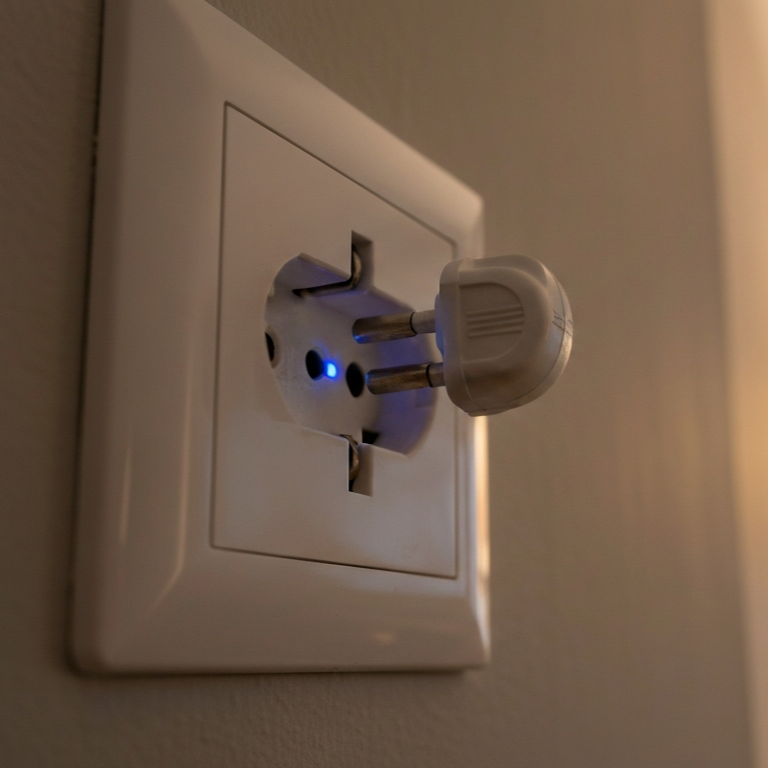
If It's the Emergency Kind, Do This Now
1. Kill the breaker for that outlet. Open the panel. If the labels are accurate, kill that breaker. If they are not, kill them one at a time until the outlet goes dead.
2. Unplug whatever's in the outlet, if you can do it safely without touching the receptacle itself. If the plug feels hot or the receptacle is visibly damaged, leave it for the electrician.
3. Don't plug anything else in. And don't move loads to the outlet "next door" — they may share the same circuit.
4. Keep people and pets back from the wall. The conductors inside the box may still be live if you killed the wrong breaker.
5. Call a licensed electrician the same day. Tell them "sparking outlet, breaker is off." They'll prioritize. Don't wait until morning.
Why the Normal Spark Is Normal
When you push a plug into an outlet, the metal contacts inside the receptacle close over the prongs of the plug. For a fraction of a second, there's a tiny air gap between them. If anything on the circuit is drawing current at that moment — a powered-on lamp, a transformer in a charger, a switch you'd already flipped — the current jumps that air gap as a small blue spark. Same effect as static electricity, same color, same physics.
That spark is harmless. It happens millions of times every day across every outlet in the country. It doesn't damage the outlet, the device, or the wire. It's the byproduct of inrush current at the moment of contact.
If the spark you saw fit that description — brief, blue, only at the instant of plug-in — you can keep using the outlet.
Why the Emergency Spark Is the Emergency
But the dangerous spark is one that keeps going, changes color, or appears when nothing is being plugged in. Each of those signals a different failure mode behind the wall.
A continuous spark with the plug already inserted means the connection between the plug's prong and the receptacle's internal contact is loose or corroded. Current is arcing across a gap that should be solid metal. The arc is generating heat at the contact point — that heat the breaker can't see, because the current draw stays normal.
A yellow or orange spark is much hotter than a blue one. Yellow and orange in electrical sparks mean the arc is hot enough to vaporize metal off the contact, ignite the air, and burn the plastic body of the receptacle. Blue is the normal color of a brief electrical arc in air; yellow/orange means something is being consumed.
A spark from an empty outlet means something inside the receptacle or the wires behind it is failing on its own — without any load applied. That's the most dangerous version, because it means the failure has progressed far enough to arc with only the line voltage present. There's no "well, it only happens when the heater is on" — it's happening with the outlet just sitting there.
And in all three of these cases, the breaker won't help you. Breakers detect current overage, not arcing. AFCI breakers (arc-fault circuit interrupters) are designed specifically for this — they detect the electrical signature of an arc and trip the circuit — but most older panels don't have them on every circuit.
What an Electrician Does About It
A sparking-outlet service call is usually one to three hours. The electrician confirms the breaker is off with a non-contact voltage tester, then pulls the receptacle. They look for discoloration, melted plastic, scorch marks, loose terminals, damaged conductors, and any sign of arcing inside the box. Adjacent outlets on the same circuit get opened too — a failure at one device often means the next outlet is close to its own.
The damaged receptacle gets replaced. Any conductor with heat damage gets cut back to clean copper and re-terminated. The new device gets landed on the screw terminals — not backstabbed. The circuit is tested under load before the electrician leaves.
If the panel doesn't have AFCI protection on the affected circuit, this is a good moment to add it. AFCI breakers cost more than standard breakers, and they're a direct upgrade in the same panel slot. They'll catch the next version of this failure before you smell anything.
Frequently Asked Questions
The brief spark at the moment of plug-in is normal. If it's a sustained spark, or the wall plate is warm after, or there's a smell, that's not normal. The toaster is a heavy load, and an outlet on the edge of failing will fail under that load first.
Switches do the same thing as outlets at the moment of contact — a brief blue spark at the contact point is normal. A loud pop, a yellow spark, smoke, or a smell from the switch is the same category of emergency as a sparking outlet. Same five steps: kill the breaker, leave it alone, call same-day.
You can if you know what you're doing. The trap is that the spark may not be in the outlet itself — it could be in a splice inside the box, in a connection upstream, or in a backstabbed wire that needs to be re-terminated on the screw terminal. Replacing the receptacle without diagnosing the cause leaves the failure waiting to happen again. If you're not sure, have an electrician find the cause first.
AFCI breakers detect the arcing pattern that causes sparking-outlet failures, and they trip the circuit before the failure progresses to a fire. They don't prevent the underlying connection from going bad — but they catch it early. AFCIs are increasingly required on residential circuits. If the affected circuit doesn't have one, ask the electrician to install one as part of the repair.
Fast enough that the seconds you spend "just checking" matter. A sustained arc inside a wall cavity can ignite paper, insulation, or wood framing in minutes. Once the cavity is on fire, the failure is no longer something a breaker can stop.
The Decision Is Easier Than You Think
The whole question — "is this an emergency?" — comes down to color, duration, and whether anything else is going on. Blue and brief at the moment of plug-in is fine. Anything else is the kind of thing you call an electrician about the same day. Erring on the side of "call them" costs a service call. Erring on the side of "it'll probably be fine" can cost the house.
