Whole-House Surge Protector: What It Guards Against
Quick Answer: A whole-house surge protector, technically a surge protective device (SPD), wires into your electrical panel and clamps large voltage spikes before they reach the branch circuits that feed your appliances and electronics. It diverts the excess energy safely to ground in a fraction of a second, then resets and waits for the next event. It does not replace grounding or a battery backup, and it wears out over time.
Your home runs on a nominal 120 volts at each outlet, give or take a small window that equipment is built to tolerate. A surge is a brief, steep jump above that window, sometimes to several hundred or several thousand volts, lasting only microseconds. That spike is short, but it carries enough energy to punch through the thin insulation and delicate junctions inside modern electronics.
The damage is rarely dramatic. Sometimes a single big surge kills a television outright. More often, small repeated spikes chip away at circuit boards, power supplies, and LED drivers until a device fails months later and nobody connects it to the electrical event that started it. Anything with a microprocessor, meaning your furnace control board, smart thermostat, garage opener, dishwasher, and phone chargers, sits in the blast radius.
A surge protective device sits between that spike and your equipment. When voltage climbs past a set threshold, the SPD's internal components switch from nearly non-conducting to strongly conducting almost instantly, opening a low-resistance path that shunts the excess current away from your circuits and into the grounding system. Once voltage drops back to normal, the device returns to its resting state. Understanding that divert-and-reset behavior is the key to everything else below.
Where Surges Come From
Most people picture a lightning strike, and lightning is real, but it is the rarest cause. The surges hitting your panel fall into three broad groups.
External strikes and grid events: A nearby lightning hit can induce a spike on the utility lines even without touching your house directly. Separately, the utility switches large loads on and off across the grid, and each switching operation can send a transient down the line to your meter. These arrive from outside and can be large.
Internal motor cycling: This is the surprise for most homeowners. The biggest single source of surges is inside your own walls. Every time a large motor stops, the collapsing magnetic field kicks a voltage spike back onto your wiring. Your air conditioner compressor, refrigerator, well or sump pump, garage door opener, and even a large power tool all do this every time they cycle off. These internal surges are smaller than a lightning event but far more frequent, and they happen in every season, not just during storms. A refrigerator alone may cycle dozens of times a day, year-round.
Because internal cycling never stops and grid switching runs continuously, surge exposure is a constant background condition rather than a seasonal one. A house is being nibbled at in January and July alike.
How a Panel SPD Clamps and Diverts
A whole-house unit mounts at or beside the main electrical panel and connects to the incoming line conductors and the grounding system. When it senses voltage above its clamping level, it opens that low-resistance path to ground and diverts the surge current away from the branch circuits. The clamped-down remainder that continues past it is small enough for equipment to absorb.
There are two placements you will hear named.
Type 1 devices are rated to connect on the line side, ahead of the main breaker, and are built to take the larger transients that ride in from the utility. Type 2 devices connect on the load side, inside the panel after the main breaker, and handle the surges that have already entered the premises, including all that internal motor cycling. Many homes are well served by a Type 2 unit at the panel; some setups use a Type 1, and a Type 1 device can also be installed at a load-side location where its rating permits. A licensed electrician will assess your specific service and grounding before making a recommendation.
Whichever type, the device only works if the panel is properly grounded and bonded. The SPD needs somewhere to send the diverted energy. A unit wired into a panel with a compromised ground path cannot do its job, which is one more reason the install belongs with a professional who verifies the grounding at the same time.
Joules and Clamping Voltage in Plain Terms
Two numbers describe an SPD, and both are easy to misread.
The joule rating is roughly how much surge energy the device can absorb over its lifetime before its internal parts are used up. Think of it as a fuel tank rather than a wall. A higher joule rating means the unit survives more and larger events before it is spent. It is a capacity, and it drains.
The clamping voltage is the level at which the device kicks in and starts diverting. A lower clamping voltage means the SPD steps in sooner and lets less spike through to your equipment. Lower is generally better for protection, within the ratings the device is designed for.
Reading them together tells the story: clamping voltage is how tightly the device holds the spike down on any single event, and the joule rating is how many events it can do that for before it needs replacing.
What a Surge Protector Does Not Do
An SPD is one layer, not a complete electrical safety system, and knowing its limits keeps expectations honest.
It does not replace grounding. Grounding is what gives the diverted surge a safe destination; the SPD depends on it and cannot substitute for it.
It does not replace a UPS or battery backup. A surge device clamps voltage spikes; it does nothing for the opposite problem of power loss or a brownout. If your equipment needs to ride through an outage- a computer that cannot lose a file mid-save, a medical device, a network rack- that is a battery backup's job. The two solve different problems and are often used together.
It does not stop every last volt. A panel SPD clamps the large stuff and lets a smaller residual through. That residual is where the next layer comes in.
Why Layering Beats a Single Device
A whole-house SPD at the panel is the first and heaviest line of defense, catching the big external and internal surges before they spread through the house. But it sits far from your sensitive electronics, and the small residual it passes, plus any surge generated downstream by an appliance on the same circuit, can still reach a delicate device.
That is why layered protection works best. Pair the panel SPD with quality point-of-use strips at the equipment that matters most, meaning your computer, home theater, and network gear. The panel unit takes the heavy hit; the plug-in strip mops up the smaller residual right at the outlet. The plug-in layer is homeowner-safe to install; it simply plugs in, so anyone can add it. Think of the panel device as the storm shutters on the whole house and the plug-in strips as the padded case around the one camera you cannot replace.
The Indicator Light and When It Is Spent
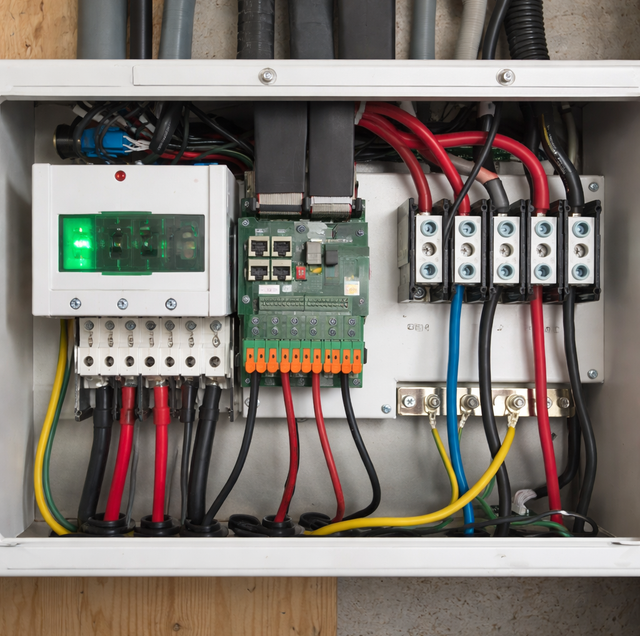
Every panel SPD has a status indicator, usually a small light or window. A steady lit indicator generally means the device is live and protecting. When that indicator goes dark or changes color per the unit's legend, the internal components have absorbed their rated energy and the device is spent, meaning it is no longer clamping even though power still flows to your house normally.
This is the part homeowners miss. After a known large event, a close lightning storm, or a reported utility disturbance, check it sooner. Replacement is a like-for-like swap done by an electrician.
A spent SPD does not cut your power, so the house can sit unprotected until someone notices the status indicator. Glance at the light a couple of times a year, and check it sooner after a close lightning storm or a reported utility disturbance.
Why This Is Licensed Work
A plug-in strip is homeowner territory. A panel-mounted SPD is not.
Installing a panel-mounted SPD means opening the electrical panel and connecting to the busbars, which stay energized at lethal voltage even with the main breaker switched off, because the utility feed lands ahead of that breaker. There is no safe way for a homeowner to work near live service conductors. Do not open the panel yourself.
Frequently Asked Questions
There is no fixed calendar date, because lifespan depends on how many surges the unit absorbs, not how many years pass. A home with heavy motor loads or frequent grid disturbances drains the device faster than a quiet one. Rather than tracking a date, watch the status indicator; it reflects actual wear, which is the only number that matters. Many owners find a replacement is due somewhere in the range of several years to a decade.
Both can happen, depending on the hit. The metal-oxide varistors inside absorb energy in joules, and a single very large event, like a nearby lightning strike, can spend the whole device at once, which is why a quality unit sacrifices itself to save the panel. Far more often it degrades in small steps, taking a little damage from each of the everyday internal surges until its clamping ability fades. That is what the status indicator tracks: a green light means it is still protecting, and a changed or dark light means it is spent and needs replacing even while your power still works normally.
No, they cover different distances. The panel unit stops large surges at the point of entry but sits far from your electronics and passes a small residual. It also cannot catch a surge born downstream, such as a laser printer on the same circuit kicking back when it cycles. A plug-in strip at the outlet handles that close-in residual, which is why layering the two protects sensitive gear better than either alone.
The panel-mounted type is not a homeowner job. Wiring it means working inside the panel near busbars that stay energized at lethal voltage even with the main breaker off, since the utility feed enters ahead of that breaker. A plug-in strip, by contrast, is fully homeowner-safe because it simply plugs into an existing outlet with no panel access. The dividing line is whether the panel has to be opened.
Yes, grounding is not optional for it to function. The device works by diverting surge energy to the grounding system, so a missing or corroded ground path leaves that energy nowhere safe to go and the SPD cannot protect anything. This is why a proper install includes checking the home's grounding and bonding, not just mounting the unit. A good ground is what turns the device from decoration into protection.
They guard against different faults entirely. A circuit breaker trips on sustained overcurrent, too many amps flowing for too long, and it opens the circuit to prevent overheating and fire. An SPD reacts to a voltage spike lasting microseconds, far too brief to trip a breaker, and it diverts rather than disconnects. A breaker protects the wiring from heat; an SPD protects your equipment from voltage. Having one does not cover the other.
Ask Ridgeline Electric to add panel-level surge protection — one visit shields every circuit in the house. Ridgeline Electric serves Santa Cruz, Capitola, and Scotts Valley. Call (831) 206-5602.
