
Signs Your House Needs to Be Rewired
Most homes don't announce that they need to be rewired. The wiring sits behind drywall and plaster for decades, doing what it was installed to do — until at some point it can't keep up with what the modern home demands.
The signs aren't loud. But they're consistent, and most of them can be spotted without opening a single wall.
The ten most common signs, in roughly the order an electrician would weigh them. The "drop everything and call tonight" signs are flagged for what they are.
The Age-of-the-System Signs
These say "your wiring belongs to a different era of how houses used electricity." None are emergencies on their own. But each one shrinks the safety margin a modern home should have.
1. The House Was Wired Before 1965 and Has Never Been Rewired
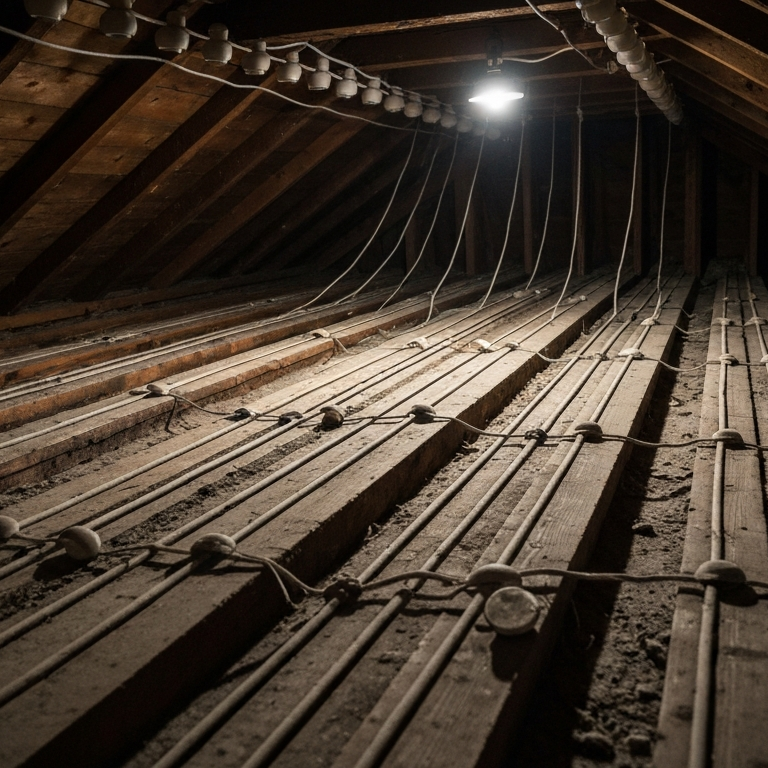
The 1965 line isn't magic. But it's close. Homes wired before that era used either knob-and-tube (cloth-and-rubber-insulated conductors run through ceramic insulators) or early cable without a ground wire. Both systems work when intact. The insulation degrades. The splices were never designed for modern loads. And the lack of a ground means GFCI and AFCI protection — the two devices that save lives in modern homes — can't do all of what they're designed to do.
If your home is from this era and the wiring has never been replaced, a rewire is on the horizon. The question is when, not if.
2. The Home Has Single-Strand Aluminum Branch Wiring (1965–1973-ish)
For about a decade, aluminum was used in branch-circuit wiring — the wires that run from the panel to outlets and switches. The metal itself is fine. The problem was that the terminations and devices used with it weren't designed for aluminum's behavior. It expands and contracts more than copper as it heats. It forms a high-resistance oxide layer where it meets other metals. The result is connections that loosen, heat up, and eventually arc.
Three accepted ways to deal with it: replace the wiring completely (full rewire), install special CO/ALR or AlumiConn-style splices at every connection, or have COPALUM crimps installed where available. Insurance carriers care about this. Many won't write new policies on homes with aluminum branch wiring until one of those three remediations has been done.
3. There Is Knob-and-Tube Wiring in Active Use
Knob-and-tube was the first electrical wiring system installed in American homes. And a surprising number of houses still have stretches of it in active use — especially in attics, basements, and walls of additions that pre-date the 1950s. K&T was a quality system in its day. It isn't safe with today's loads, today's insulation (which surrounds the wires and traps heat the system was never designed for), and today's grounded appliances.
If an electrician identifies live knob-and-tube in your home, the conversation isn't whether to replace it. It's whether to do a partial rewire of just the K&T runs, a whole-home rewire, or stage the work over time.
The Outlet and Receptacle Signs
These are the signs you can spot by looking at the wall.
4. Most of the Outlets Are Two-Prong (Ungrounded)
A two-prong outlet means the circuit feeding it doesn't have a ground wire. Without a ground, any appliance that depends on a ground for safety — and modern appliances do — is operating outside its intended design. Adapters that turn a two-prong outlet into a three-prong opening do nothing to add the missing ground. They just hide the problem.
Two paths forward. The conservative one is a full rewire, which solves the missing ground everywhere at once. The bridge solution, often used in older homes that aren't ready for a rewire, is to have an electrician install GFCI protection on each two-prong outlet, label them "no equipment ground," and accept that the home's grounding situation is on the books for the next owner.
5. The Receptacles Feel Loose, Warm, or Discolored
Modern receptacles grip a plug firmly and stay at room temperature when something is plugged in. A receptacle that feels loose, runs warm, or shows yellow or brown discoloration around the slots is on the way to failure. The cause could be a worn device, a loose connection inside the box, or a circuit that's been overloaded for years. Whatever the cause, the next step is for an electrician to open the box and check what's happening behind the cover.
If multiple receptacles around the house are warm or discolored, the problem is the wiring system itself, not the devices. A rewire is the durable fix.
The Behavior-of-the-Panel Signs
These show up at the panel rather than at individual outlets.
6. Breakers Trip on Normal Household Loads
Breakers are protective devices. They trip when a circuit is overloaded — too many things drawing power at once — or when there's a short or ground fault. Occasional trips are fine. Frequent trips on normal household use are not.
If a kitchen breaker trips every time the toaster and the coffee maker run together, the kitchen needs more circuits. If a living-room breaker trips when the vacuum runs, the wiring serving that room is undersized for what the room is doing. Breakers tripping at random — sometimes with nothing on — usually means a fault on the circuit. A loose connection or a damaged conductor. Needs to be found.
A house that needs three or four breakers reset every week has a wiring problem, the panel is doing its best to compensate for. A rewire or at least a circuit-by-circuit upgrade is the answer.
7. The Panel Itself Is Obsolete, Crowded, or From a Recalled Manufacturer
A handful of panel brands from the 1950s through the 1980s have known reliability problems. Electricians and inspectors flag them on sight. Some are no longer made and replacement breakers are hard to find. Some have been the subject of long-running concerns about whether the breakers actually trip on fault conditions.
The panel itself is rarely "in scope" of the wiring that runs through the walls. But a home that needs a full rewire usually needs the panel replaced too. They tend to be the same age, and the rewire is the right moment to bring the service equipment up to current standards.
The Smell-and-Sight Signs
These demand immediate attention.
8. There Is a Burning, Plastic, or Fishy Smell Near a Switch, Outlet, or Fixture
This is the "do not wait" sign. A burning or fishy plastic smell at a switch, outlet, or fixture means something is overheating inside the wall. The fishy smell in particular is the byproduct of melting plastic — usually a thermoplastic switch or device burning slowly enough not to set off a smoke alarm but hot enough to be a fire hazard.
Smell it? Turn off the breaker that feeds that part of the house and leave it off. Don't unplug anything hot. Call an electrician the same day.
9. Lights Flicker on Specific Circuits or When Big Loads Start Up
Brief dimming when a large appliance starts (a refrigerator compressor kicking on, a microwave starting up) is normal and harmless. Flickering that happens randomly, that affects a single circuit even when nothing is starting up, or that happens across multiple circuits at the same time, is not normal.
Random single-circuit flickering usually means a loose connection on the circuit — at the breaker, in a junction box, or at a device. Flickering across multiple circuits, especially in different parts of the house at the same time, can mean a loose connection on the neutral conductor at the service entrance. That's a serious problem. In a home with old wiring, either pattern is a sign that the wiring is showing its age.
10. You Have Visible Damage, Scorch Marks, or Old Splices Inside Open Areas
If you have an unfinished basement, garage, or attic, take a flashlight up there and look at the wiring. Cloth-jacketed cable that's brittle or cracked. Splices made with electrical tape rather than wire nuts. Open junction boxes without covers. Cables stapled into joists hard enough to cut the insulation. Scorch marks on wood near a junction box.
Any of these means the wiring isn't in the condition the original installer left it in. And it's a strong sign that a rewire is in the home's near future.
How an Electrician Decides Between Full Rewire and Partial
A full whole-home rewire is the big project — all branch circuits replaced, all device boxes updated, walls opened and patched, full inspection. A partial rewire targets the highest-risk runs (the knob-and-tube in the attic, the aluminum on the bedroom circuits, the ungrounded circuits in the kitchen) and leaves wiring that's in good condition alone.
| What you have | What an electrician usually recommends |
|---|---|
| A pre-1950 home with extensive knob-and-tube still live | Whole-home rewire, staged if the budget requires |
| 1965–1973 home with single-strand aluminum branch wiring | Choose between full rewire and approved remediation (CO/ALR devices, AlumiConn, or COPALUM crimps) |
| 1970s–1980s home with copper but no grounds on most circuits | Targeted rewire of kitchens, baths, exterior, and any other GFCI-required areas; GFCI protection on remaining two-prong outlets |
| Modern home (1990s or later) with isolated symptoms | Repair, not rewire — the problem is usually a specific device or splice |
The decision isn't just about safety. It's also about practicality: how much of the wall has to be opened, how the rewire affects insulation and finishes, and how long the home will be without power on each circuit. A reputable electrician walks through both the safety case and the budget case before recommending one approach over the other.
Frequently Asked Questions
For a typical single-family home, expect one to three weeks of on-site work, depending on access and how much wall opening is required. Larger homes and homes with finished basements or plaster walls take longer. Most projects are scheduled so the home stays habitable through the work, with one or two circuits down at a time rather than the whole panel.
Almost always, on the affected walls. Even careful drywall patching needs paint to blend in, and most rewire projects open dozens of small holes. Most electricians can recommend a drywall and paint subcontractor, or coordinate with one the homeowner has used before.
Yes. A partial rewire is a legitimate option for homes where the safety problem is concentrated in a few circuits (kitchen, bath, exterior) and the rest of the wiring is in serviceable condition. The trade-off is that the partial work leaves the older wiring in place for next time — which is fine as long as the homeowner and the electrician agree on what's being done and what's being deferred.
Insurance generally doesn't pay for a planned rewire. Insurance carriers do sometimes require remediation of specific known issues (aluminum branch wiring, knob-and-tube in active use) as a condition of writing or renewing a policy. If you're getting pressure from your carrier to remediate, your electrician can give you a quote that meets the carrier's requirements without rewiring the whole home.
The range varies widely based on the size of the home, how much wall opening is required, whether the panel and service are being upgraded at the same time, and local labor rates. The best way to get a real number is to have one or two electricians walk the house and give a written scope. A scope that just lists "rewire home — $X" with no detail is not a real quote.
Most rewires are done with the home occupied. The work is scheduled circuit-by-circuit, so power is available somewhere in the home at all times. The dustiest day or two — drywall opening and patching — is the rougher stretch. Some homeowners stay elsewhere during that part.
The Wiring You Can't See Tells the Truth
The signs above are the visible part of what older wiring does as it ages. The hidden part shows up when the rewire starts. Conductors stapled tight inside joists. Splices made forty years ago without a junction box. Brittle insulation flaking off a hot wire above a finished ceiling. The visible signs are usually the leading edge of what's actually back there. Take them as a prompt to get a wiring assessment from a licensed electrician before any of them become the kind of problem that doesn't wait for an appointment.
