
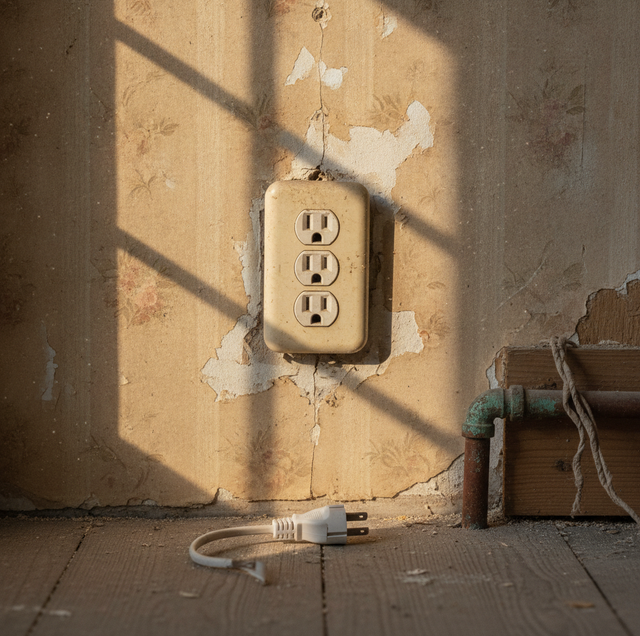
If you have ever gone to plug in a computer or a power strip and found the outlet has only two slots instead of three, you have run into ungrounded wiring. It is a common surprise in older homes, and it raises a fair question: Is this a problem, and what can be done about it?
The short version is that two-prong outlets are not automatically dangerous, but they are missing a safety feature that modern appliances and electronics expect. Understanding what that missing piece actually does is the key to picking the right fix instead of reaching for a quick workaround that makes things worse.
Quick Answer: A two-prong outlet has no ground wire, which is the safety path that carries fault current away and trips the breaker if something shorts. You have three real options: run a new grounded cable back to the panel, replace the outlet with a GFCI that protects people even without a ground, or leave the two-prong outlet in place where nothing needs a ground. Never use a three-to-two cheater plug, and leave any wiring work to a licensed electrician.
What A Two-Prong Outlet Is Actually Missing
Every standard outlet in a modern home connects to three wires. The hot wire delivers power, the neutral wire is the normal return path that carries current back once it has done its work, and the ground wire is a third path that does nothing at all under normal conditions. A two-prong outlet has the first two and skips the third.
That third wire is easy to dismiss because it sits idle almost all the time. But its whole purpose is to be ready for the moment something goes wrong. Picture a metal-cased appliance, say a toaster or a window fan, where a hot wire inside works loose and touches the metal housing. In a properly grounded circuit, that stray current has a dedicated low-resistance path straight back to the panel. The sudden surge trips the breaker within a fraction of a second, and the appliance goes dead before anyone touches it.
Think of the ground wire like the emergency exit in a building. On an ordinary day, nobody uses it, and you might forget it is there. But the one time the main path is blocked, and things go wrong, that dedicated exit is what prevents a bad situation from turning into a disaster. Take it away, and the fault current has to find its own way out; the easiest path might be through the person who happens to be touching the metal case.
Without a ground, two things change. First, a fault that would normally trip the breaker instead can leave the metal case of a device energized, which is a real shock hazard. Second, anything you plug in that relies on a ground for protection, including surge protectors and a lot of sensitive electronics, has nothing to work with. Homes wired before the mid-1960s frequently have this two-wire setup throughout, because grounded receptacles were not the standard yet when the house was built.
Option One: Run A Real Ground Back To The Panel
The most thorough fix is to give the circuit the ground it never had. That means running a new three-wire cable from the outlet location back to the electrical panel, so the outlet gets a genuine, dedicated ground path.
This is the gold-standard answer because it restores the outlet to exactly what a modern circuit is supposed to be. Once the new cable is in place, the outlet does everything a new-construction outlet does: it trips the breaker on a fault, it gives surge protectors a real path to work with, and it supports grounded appliances without compromise.
The catch is that pulling new cable through the walls of a finished older home takes work, and how involved it gets depends on how the house is built and how accessible the wall cavities are. This is why running a fresh ground makes the most sense during a remodel, when walls are already open, or when you are updating a specific circuit that feeds equipment you care about, like a home office or a media setup. If the drywall is already coming down for another reason, adding proper grounding at the same time is an efficient move.
Option Two: Replace The Outlet With A GFCI
When running new cable is not practical, there is a second option that the electrical code specifically allows. You can replace an ungrounded two-prong outlet with a GFCI outlet, the same kind of protective receptacle you see in bathrooms and kitchens with the little test and reset buttons.
Here is the part that trips people up, so it is worth being precise about what a GFCI does. A GFCI constantly compares the current going out on the hot wire against the current coming back on the neutral. Those two should always match. If even a small amount of current goes missing, meaning it is leaking somewhere it should not, such as through a person, the GFCI cuts power in a fraction of a second. It does this by watching the current itself, which is why it does not need a ground wire to protect people from shock.
That makes a GFCI a legitimate, code-accepted upgrade for an ungrounded outlet. When it is used this way, the code requires it to be labeled "No Equipment Ground," and a matching label goes on any grounded outlets fed downstream from it. That label is not fine print to ignore. It is telling you exactly what you have: shock protection for people, but still no true ground.
So be clear about what a GFCI does not do. It does not create an equipment ground out of thin air. It does not give surge protectors the path they need to dump excess energy. And it does not make sensitive electronics that call for a grounded connection any happier. A GFCI is about protecting the person standing in front of the outlet, not about grounding the equipment plugged into it. For many outlets in a home, protecting the person is exactly what matters most, which is why this option is so useful.
Option Three: Leave It, But Do It Right
The third option is the simplest: leave a two-prong outlet as a two-prong outlet in spots where nothing plugged in there needs a ground. A lamp, a clock, or a phone charger with a two-blade plug does not use a ground at all, so an ungrounded outlet serves them perfectly well.
There is one hard rule that goes with this option. Never use a three-to-two adapter, the little plug sometimes called a cheater plug, to force a grounded device into a two-slot outlet. It looks like it solves the problem because the three-prong plug now fits. It does not. The adapter lets the plug fit, but it provides no actual ground behind it, so you get all the false confidence of a grounded connection with none of the protection. If a fault occurs in that device, its metal case can still go live, and now you have hidden the warning sign that told you the outlet was ungrounded in the first place.
If you find cheater plugs already in use around the house, treat them as a flag that the wiring needs attention, not as a fix someone already handled.
How To Tell If Your Wiring Is Ungrounded
The most obvious sign is the outlet face itself: two slots and no round hole below them means no ground at that outlet. Cheater adapters plugged in around the house are another strong hint, as is simply living in a home built before grounded wiring became standard.
The tricky case is a three-slot outlet that only looks grounded. Somewhere along the line, a previous owner or handyman may have swapped a two-prong outlet for a three-prong one without running an actual ground to it. The outlet now accepts a three-prong plug, but there is nothing behind that third slot. This shows up as an "open ground" on a plug-in outlet tester, an inexpensive device that lights up a pattern telling you what is and is not connected. A false three-prong outlet is arguably more dangerous than an honest two-prong one, because it invites you to trust a ground that was never there.
Whole-Home Considerations
A single circuit is one thing, but sometimes ungrounded outlets are a symptom of something bigger. Very old homes may still have knob-and-tube wiring or cloth-insulated conductors, systems that predate modern grounding entirely. When that is what is in the walls, patching one outlet at a time often does not make sense, and a broader rewiring plan becomes the smarter long-term path. This is especially worth weighing in older housing in any damp or salt-air area, where decades of moisture can be hard on aging wiring and insulation.
Grounding also matters if you are thinking about whole-home protection. A whole-home surge protector, the kind installed at the panel to shield everything in the house from voltage spikes, needs a proper ground to function. Without one, it has nowhere to send the energy it is supposed to divert. So if surge protection is on your list, the state of your home's grounding is part of that conversation, not a separate issue.
For a newer home that simply has a few ungrounded circuits, running grounds to the outlets that matter may be all you need. For an older home with original wiring throughout, a licensed electrician can assess whether spot fixes or a larger rewiring plan is the better investment.
A Note On Safety
One theme runs through all of this: the work belongs to a licensed electrician. Opening outlets, working inside the panel, and running new wiring involve live circuits and code requirements that are truly hazardous to get wrong. This is not a weekend project, and the one shortcut that seems the most tempting, the cheater plug, is exactly the one to avoid. An electrician can test what you actually have, tell you which of the three options fits each outlet, and do the work safely.
Frequently Asked Questions
No. The adapter lets you physically plug a grounded device into a two-slot outlet, but it provides no actual ground behind it. The metal prong or tab on the adapter is only grounded if it is fastened to a grounded outlet box, which, in an ungrounded circuit, it is not. So the device thinks it is grounded when it is not, and a fault can still leave its metal case energized. The adapter defeats the very safety feature that the third prong exists to provide.
A GFCI is a real, code-accepted way to protect people at an ungrounded outlet, because it senses current leakage and cuts power without needing a ground. When used this way, it must be labeled "No Equipment Ground," and every outlet fed downstream from that GFCI has to carry the same label so no one mistakes it for a grounded circuit. Press the TEST button monthly to confirm the device still trips, since a GFCI that no longer resets offers no protection. What it does not do is create a true ground, so it will not give a surge protector a path to work or satisfy electronics that require a grounded connection.
Neutral is the normal return path that carries current back to the panel every time a device runs, so it is a busy wire under everyday use. The ground is a separate path that stays idle until a fault occurs, then gives that stray current a dedicated low-resistance route back so the breaker trips almost instantly. Neutral cannot safely take that job, because it is a current-carrying conductor during normal operation and is not intended to handle a fault the way a dedicated ground does.
Two slots and no round hole is the obvious sign. A cheap three-light plug-in tester goes further: it shows "open ground" when a three-slot outlet has nothing behind the third slot, and it also flags reversed hot and neutral. Its blind spot is a bootleg ground, where someone jumpered the neutral over to the ground screw so the tester reads as grounded even though no real ground exists. Catching that trick takes an electrician, who can open the box and confirm whether the ground terminal actually runs back to the panel.
Yes, especially surge protectors. A surge protector works by diverting excess voltage away from your equipment and dumping it to ground during a spike. On an ungrounded circuit, there is nowhere for that energy to go, so the surge strip cannot do its job even if it physically plugs in and its light glows green. Many sensitive electronics also expect a grounded connection for stable operation and noise reduction, which an ungrounded outlet cannot provide.
It depends on what is in the walls. Knob-and-tube and cloth-insulated wiring usually have no ground conductor in the run at all, so there is no ground to reconnect, and you cannot simply add one, which pushes those homes toward a rewire rather than grounding a few circuits. A more modern-era home that merely lacks grounds on a few circuits may only need new grounds run to the outlets that matter, such as a home office or an entertainment area. A licensed electrician can inspect the wiring and tell you which situation you are in.
Have an electrician test your outlets and map out the right grounding fix — so your home is protected and your electronics have the ground they need. Ridgeline Electric serves Santa Cruz and the surrounding area. Call (831) 206-5602.
