Level 1 vs Level 2 EV Chargers: Which Do You Need at Home?
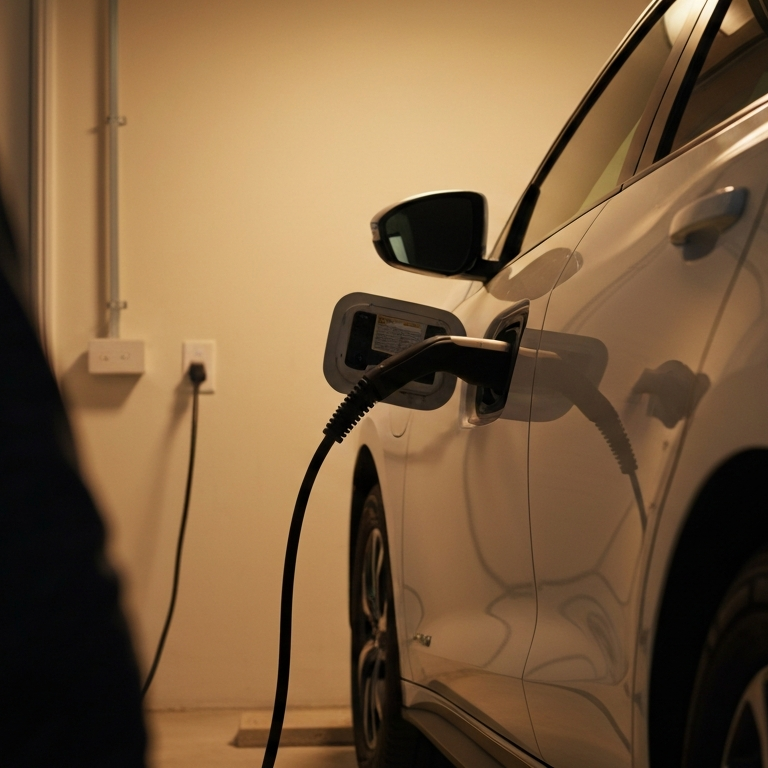
You just took delivery of the car. The dealer threw a Level 1 charging cable in the trunk and pointed at the household outlet in your garage. "You'll be fine." A week later, you are checking the app twice a day, doing math about how many miles you have left, and skipping a side trip because you're not sure the charge will hold.
That's the moment most homeowners decide whether they actually need Level 2. The short version: it depends on how far you drive and how long the car sits in your garage overnight. The long version is one short multiplication problem and a clear answer.
This walks through the math, the installation cost difference, and which one fits which driving pattern.
The Charging-Speed Math
So Level 1 uses the 120-volt outlet already in your garage. The mobile cable that came with the car plugs into it. No electrical work needed on day one — just plug in. It delivers between 1 and 2 kW of charging power, which, on a typical efficient EV, translates to about 4-5 miles of range added per hour of charging.
Level 2 uses a 240-volt circuit — same voltage as your electric dryer or oven, just on a dedicated branch circuit. The cable can be either hardwired to a wall-mounted unit or plugged into a 240-volt outlet. Power delivery is typically 7-11 kW on a residential installation, which adds 25-40 miles of range per hour.
| Level 1 | Level 2 | |
|---|---|---|
| Voltage/amperage | 120V / 12-16A | 240V / 30-48A |
| Power delivery | 1-2 kW | 7-11 kW |
| Range added per hour | 4-5 miles | 25-40 miles |
| Full charge from 20% to 80% on a typical EV | 30-50 hours | 4-8 hours |
| Hardware | Mobile cable in the trunk | Wall-mounted EVSE, hardwired or 14-50 plug |
| Electrical installation | None | New 240V dedicated circuit + 40-60A breaker + (optional) wall unit |
| Typical installation cost | $0 | $800-$2,500 for the electrical work; $400-$1,000 for the unit |
| Best fit | Short daily commute, long overnight window | Long commute, multi-EV household, road tripper |
The numbers tell you most of what you need to know. The next question is which row of "best fit" applies to your household.
The 40-Mile Question
Here's the simplest way to figure out whether Level 1 is enough. Take your daily driving in miles. Multiply by your car's miles-per-kWh (most EVs sit around 3.5-4 mi/kWh). Divide by the Level 1 power delivery (call it 1.4 kW). That's how many hours of plugging in you need each day to break even.
For a 40-mile-a-day commuter in an efficient EV:
> 40 miles ÷ 4 mi/kWh = 10 kWh needed > 10 kWh ÷ 1.4 kW = 7.1 hours of Level 1 charging per day
If your car sits in the garage for 10+ hours overnight, Level 1 covers you with margin. Plug in when you get home. Unplug when you leave. The car is full every morning. No thinking about it.
For an 80-mile-a-day commuter:
> 80 miles × (1 ÷ 4 mi/kWh) ÷ 1.4 kW = 14.3 hours
Now you're over your overnight window. You'd need to be plugging in at work, too, or upgrading to Level 2 at home.
For a household with two EVs:
> Two cars × 40 miles each × (1 ÷ 4 mi/kWh) ÷ 1.4 kW = 14.3 hours of total charging
Both cars sharing one Level 1 outlet doesn't work. Either two outlets or one Level 2 — and a single Level 2 is usually the cleaner answer because it can fill both cars overnight.
When Level 1 Actually Holds Up
A surprising number of households do fine on Level 1 — much more than the dealer or the internet will admit. The pattern that works is:
Daily driving averages under 40 miles
The car is at home for at least 10 hours overnight, with a 120-volt outlet within reach of the charge port
You don't take frequent unplanned road trips that drain the battery and need a fast top-up before the next day
One EV in the household (not two sharing the same overnight window)
And in that pattern, Level 1 is genuinely free. The cable came with the car. The outlet was already there. The car is full every morning. You'll occasionally take a weekend trip that drains the battery and requires a public DC fast charger on the way home — but on an everyday basis, the math works.
And this is why dealers shouldn't push Level 2 universally. Plenty of buyers are paying for an installation they didn't need.
When Level 2 Starts Paying for Itself
Five situations push you toward Level 2.
You drive more than 40 miles a day. The Level 1 math runs out of the overnight window. Level 2 covers you in a fraction of the time.
You have two EVs. One Level 2 handles both cars overnight. Two Level 1 outlets don't.
You take frequent unplanned drives. A job that pulls you out for a 60-mile site visit you didn't see coming. Kids' sports tournaments two counties over. Anything where you need the car full when you didn't expect to need it. Level 2 means you can top off in two hours during dinner.
Your overnight window is short. Shift worker. A multi-driver household with the car coming and going. Anyone whose car spends less than 8 hours plugged in overnight.
You are future-proofing. Heat pump, induction range, EV — the modern home draws more power than the same house did fifteen years ago. If a panel upgrade is on the horizon for any of these reasons, adding the Level 2 circuit at the same time is much cheaper than coming back for a second pull.
What the Installation Actually Involves
A Level 2 installation is a dedicated 240-volt circuit from the main panel to the location where the charger will mount. The components:
A new 40 or 60-amp double-pole breaker in the panel
Copper conductor sized for the breaker and the run length
Conduit (in unfinished basements and garages, sometimes surface-mounted; in finished spaces, in-wall where possible)
Either a 14-50 receptacle or hardwiring directly to the charger
The EVSE itself (the wall-mounted unit), if it's hardwired
On a single-family home where the panel is in the garage or basement near the parking spot, the installation can be a half-day, $800-$1,200 job. On a home where the panel is on the opposite side of the house from where the car parks, the run gets longer and the installation can stretch toward $2,500. A panel upgrade adds another $2,500-$5,000 if the existing service doesn't have room for a 40-60 amp circuit.
The unit itself runs $400-$1,000 for a residential wall-mounted charger from a reputable brand. The most expensive units add app integration, load management, and reporting features. The cheapest functional units work fine for everyday charging.
Frequently Asked Questions
No, and don't try. The dryer outlet is 240V — your Level 1 cable is rated for 120V. Plugging Level 1 into a 240V outlet damages the cable and the car. There are adapter cables for going from Level 2 outlets to other 240V plug types, but those are different products. If you have a spare 240V outlet you want to use for charging, get the right EVSE for it.
Both — the power delivery is voltage times amperage. Going from 120V/15A (about 1.4 kW) to 240V/40A (about 9.6 kW) is roughly a 7x speed-up because both numbers went up at once. That's why Level 2 isn't just "twice as fast" — it's the better part of an order of magnitude.
Yes. The dedicated 240V circuit is permitted electrical work — it needs to be inspected. Skipping the permit creates problems at home sale and can violate the EVSE manufacturer's warranty terms. A real electrician's quote includes the permit and the inspection.
Mounting the box on the wall is straightforward. The 240V circuit feeding it is electrical work that needs a licensed electrician and a permit in most jurisdictions. Plenty of homeowners mount the unit themselves and have the electrician do the circuit.
Sort of. A 14-50 is a 240V outlet (the same one you'd see on a welder or some RV connections). If you install a 14-50 and plug a Level 2 EVSE into it, the system is Level 2. The outlet itself isn't a charger — it's a 240V receptacle that an EVSE plugs into.
No. EV batteries are designed for daily Level 2 charging. The thing that wears batteries faster over time is frequent DC fast charging (the public 150-350 kW chargers) — and even that effect is small on modern packs. Home Level 2 is the gentlest regular charging mode you can use.
Pick the One That Fits Your Driving, Not the Catalog
The "right" answer between Level 1 and Level 2 has nothing to do with which one is fancier. It comes down to how far you drive each day and how long the car sits at home overnight. If you drive under 40 miles and park for 10+ hours, Level 1 is free and works. If you drive more than that, share with another EV, or want the car full in a couple of hours when something unexpected comes up, Level 2 pays for itself in the first month of not thinking about it. A licensed electrician can quote the installation in one visit and tell you whether your existing panel can handle the new circuit or whether a panel upgrade should be part of the same project.
