
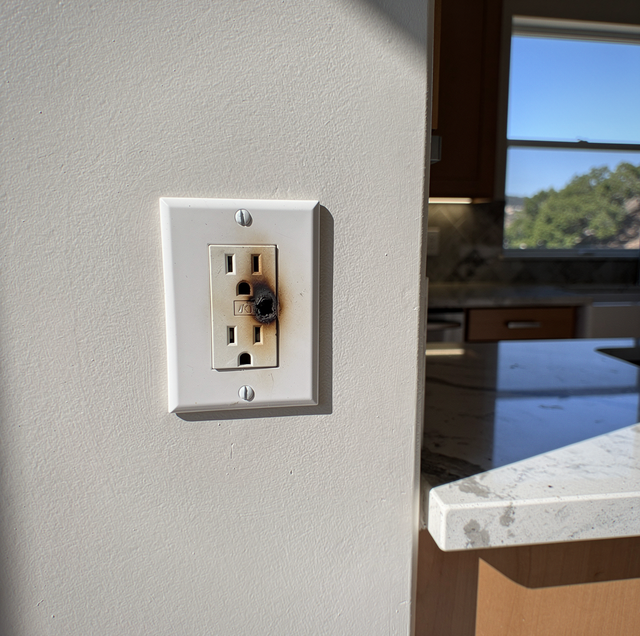
Quick Answer: One blue-white snap at the instant a plug meets the receptacle is normal inrush. Sparking that continues, happens on its own, smells hot, buzzes, scorches, or happens at the panel is not. Stop using that circuit and call an electrician.
The plug is halfway into the wall when a blue-white snap flashes at the edge of the blades. It is over before you are sure you saw it; the lamp comes on, and you forget about it. A week later, the same receptacle does it with nothing in your hand as you walk past.
Those two flashes look nearly identical for the tenth of a second they last. Only one of them is telling you something is wrong.
One Snap at the Plug Is Not the Same Event as a Spark on Its Own
As the plug blades slide toward the receptacle contacts, the gap between them shrinks to a fraction of a millimeter, and the voltage across that shrinking gap is enough to ionize the air inside it. Current starts flowing before the metal touches. That flow across the last sliver of air is the flash.
What makes it bright is what sits on the other end. Anything with a switching power supply- a television, a laptop brick, an LED driver- has a capacitor across its input that sits empty until power arrives, and charging it draws a surge several times the device's running current. An incandescent lamp does the same for a different reason: cold tungsten has only a fraction of its hot resistance, so it draws a large current until the filament heats.
The normal version has a shape. It happens at the moment of insertion, never before or after. It is one snap, not a series, and nothing is left behind: no sound, no smell, no mark on the face.
Six things move a spark out of that category. It counts if the sparking continues after contact is made, if it occurs with nothing inserted or removed, or if it is accompanied by a hot-plastic or fishy smell. It also counts if you hear a buzz, hum, or crackle from the wall, or find browning or scorching at the slots; any spark at all at a panel counts, however brief it looks.
Why a Failing Connection Can Arc Without Tripping the Breaker
A connection fails by getting smaller before it fails by coming apart. A terminal screw backs off a quarter turn. A spring clip relaxes after years of heating and cooling. A contact corrodes. The wire still carries the load, but through a shrinking patch of metal, so the current crowds into what is left. Resistance climbs, the joint heats, the heat loosens it further, and eventually the two pieces separate far enough that current jumps the gap instead of crossing it.
That arc sits in series with whatever the circuit is running, which means the load, not the fault, still sets the current. A lamp pulling half an amp keeps pulling about half an amp, arc or no arc. The breaker is watching for exactly two things: current above its rating held long enough to matter, and the instantaneous surge of a dead short. A series arc produces neither.
The temperature is another matter. An arc runs hot enough to melt copper, which takes roughly 1,980 degrees Fahrenheit, and it does that inside a plastic box against wood framing. So the breaker's silence is not evidence the circuit is healthy. On a series arc, silence is what a perfectly good breaker does, because the fault is invisible to the quantity it measures. A separate class of device reads the electrical signature of an arc rather than its size, which is its own conversation with an electrician.
What to Do in the First Few Minutes
Stop using the circuit, not just the outlet. A spark at one receptacle is often fed by a failing connection at a different device upstream on the same run, because receptacles are commonly wired in a chain and the current for all of them passes through the terminals ahead of them. Moving the lamp to the next wall can put the same load through the same bad joint.
Switch that circuit's breaker off, if and only if the panel can be operated normally from the front of a closed cover. That means the cover is in place and secured, the breaker is identifiable, the handle moves the way it always has, and the panel is quiet, cool, and free of any smell. If the panel is what sparked, or is buzzing, warm, or smells of hot plastic, do not go to it at all.
Unplug what is safely reachable once the circuit is dead. If the receptacle face is scorched, cracked, or discolored, leave the cord in it rather than putting a hand beside a damaged device to retrieve a phone charger.
Then call, and describe what you saw: whether it happened once or repeated, whether anything was being plugged in, whether there was a smell or a sound, and whether the breaker tripped on its own.
Visible flame, smoke coming from a receptacle or panel, or sustained crackling inside a wall is not a troubleshooting situation.
If you see flame or smoke, or hear sustained crackling behind a wall, do not fight it and do not put water on an energized circuit. Get everyone out of the building, then call the fire service from outside.
A Spark at the Panel Belongs in a Different Category
A receptacle is the end of one circuit. The panel is where every circuit begins.
Behind the deadfront cover are the bus bars each breaker clips onto, the lugs where the incoming service conductors are torqued down, and the neutral and ground bars where dozens of conductors land within an inch of one another. A branch circuit can deliver what a 15- or 20-amp breaker allows. The fault current available at the service equipment upstream is not measured in tens of amps.
A sparking receptacle also has a breaker upstream of it that you can reach from outside the equipment. A panel has no equivalent: there is no homeowner-reachable switch between the utility and the panel's own bus.
The main breaker at the top of a panel cuts power to the circuits below it, not to the service conductors feeding the panel itself. Those remain active until the utility disconnects service at the meter.
What sparks at a panel is rarely small: a breaker's stab connection to the bus that has loosened, a lug that relaxed under load cycling, or a bus already pitted by an arc it has carried for months. Bus damage is not a quick part swap because the bus is structurally connected to the panel.
Which is why the response to a spark at a panel is to touch nothing on it: not the cover, not the deadfront screws, not a breaker handle, and not a breaker you were thinking of pulling out and reseating to see whether that helps. Within a panel, some of it stays live even when a handle is off.
What an Electrician Actually Does on the Call
The first move is not opening anything. It is confirming that what should be dead actually is, with a meter rather than with the position of a switch, because panel labels are often wrong and a house added onto over decades can feed one room from two directions.
Heat is read next, before anything comes apart. A high-resistance joint runs hot under load long before it leaves a mark, so a thermal camera across a closed panel cover or a row of loaded receptacles often points straight at the bad connection with everything still closed up.
At the device, the receptacle is removed, and both terminations are inspected for pitting on the contacts and heat damage to the insulation running back into the box. That last item decides the repair: if the insulation has been cooked past the point where it is sound, landing that same conductor on a new receptacle is not a fix, and the run gets cut back to clean wire.
At the panel, lugs are checked against the torque value marked on the equipment with a torque screwdriver rather than by feel, and every breaker stab is inspected for discoloration indicating an arc has been present there.
Whoever wired the house wired every device on that run the same way, so one bad termination in a bedroom usually means the same method in the other bedrooms. Whether the resulting work rises to the level covered by a permit depends on where you live and is a question for the local authority, not an assumption in either direction.
The Failures Behind Almost Every Spark, Most Common First
Four failures cover most of what actually sparks, and three of them sit at a device, where the same connections that make an outlet run warm are the ones that eventually arc.
Back-stabbed receptacle connections are the most common of the four: the wire rests on a small spring clip rather than being clamped under a screw terminal, and the clip loses tension with each heating and cooling cycle. Worn internal contacts in an older receptacle come next, and once their grip on the plug blades goes intermittent, every interruption while a load is running is a small arc right at the slots. Aluminum branch wiring at a device is uncommon, since solid aluminum branch circuits were run in houses for only about eight years starting in the mid-1960s, but where it is present it is disproportionately dangerous, and it fails at the termination rather than mid-run.
Loose lugs and a failing bus in the panel are last by frequency and first by consequence. Load cycling, corrosion, and a termination never brought to its marked torque all end in the same place, and unlike the first three, none of it is reachable from the front.
The two most common causes are also the two most likely to have been repeated in every room of the house on one afternoon.
Frequently Asked Questions
The damage an arc does is cumulative and runs one direction. Each arc erodes metal from the contacts and leaves carbon on the plastic body between the terminals. Carbon conducts, so the deposit becomes a partial path that makes the next arc easier than the last. A connection that has arced once is worse afterward, and nothing about ordinary use moves it back.
They address a different problem. A surge protector clamps a voltage spike lasting microseconds by shunting the excess to ground; it is not managing the steady 120 volts a bad connection is failing at. A strip also adds two more sets of contacts to the same current path: its plug in the wall and its internal contacts, each capable of the same fault.
It is the receptacle body and the wire insulation off-gassing. Those parts are thermoset plastics containing flame-retardant additives, and heating them above their rated temperature drives off compounds most people describe as fishy or like urine rather than smoke. The smell needs no flame and no visible damage: by the time you notice it, something in that box has run well above its rating.
By design, a switch arcs at its contacts every time you operate it, which is why a faint snap inside a switch is ordinary. General-use switches are rated for tens of thousands of operations before that arcing wears the contacts out. The signs it has passed that point are a mushy or slow handle, a louder snap, or warmth at the plate.
An arc that runs long enough can burn a conductor or a terminal completely open, interrupting the circuit by destroying the connection rather than by any device operating. A dead circuit with the breaker still on points hard at that. It is not a resolution. The open point is a burned splice inside a box in a wall, and it stops being open the moment anything bridges it again.
An arc that burned itself out leaves a cold, quiet, ordinary-looking outlet, and the electrician arrives with no symptom. A photo of the scorch pattern, plus a note of what was plugged in, what else was running, and whether the spark repeated, narrows the search to one circuit and often to one device. Take it after the breaker is off, from a normal standing distance, and never in place of or ahead of killing the circuit.
Get a sparking outlet or panel looked at the same day — an electrician can find the failing connection, replace what the heat damaged, and check the rest of the circuit for the same fault. Ridgeline Electric serves Santa Cruz and the surrounding area. Call (831) 206-5602.
