
Parking Lot Lights Flickering or Cycling Off? Don’t Re-Lamp Yet
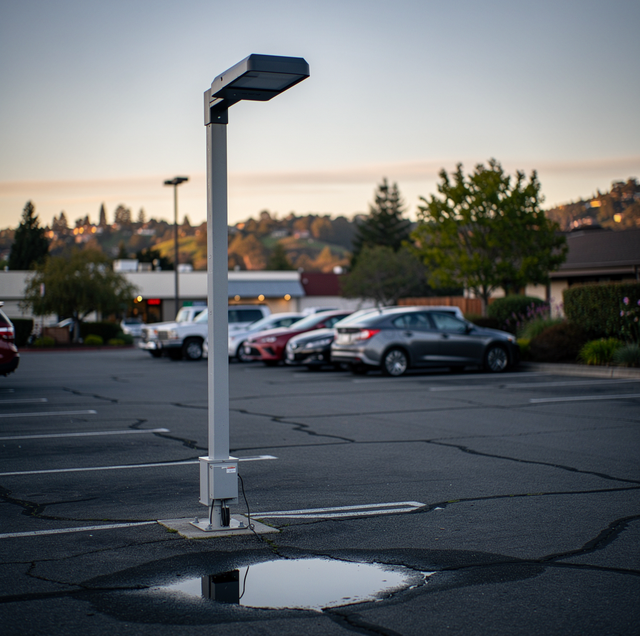
A tenant emails at nine on a Tuesday night about three poles along the north row: on, then dark, then on again, roughly a minute apart. By the following afternoon the lot looks fine, because every fixture is off and nothing about a cold aluminum head suggests what it did after dusk. The complaint arrives without evidence, and the evidence only exists in the dark.
Flickering and cycling get logged as one problem and repaired as one problem, which is why the same pole often comes back a month later. They are separate faults with separate causes, and the pattern your night staff describes will narrow that list for you before anyone brings a lift onto your property.
Flicker and Cycling Off Are Not the Same Complaint
Start with the words, because they name two different behaviors at the head. A flickering head stays lit and varies its output, fast enough to show as a shimmer from across the asphalt and slow enough that nobody can time it. A cycling head does something else entirely. It extinguishes, the bay under it goes black, and some interval later the light comes back.
The interval between dark and relight is the single most useful thing anyone on your site can capture, because each family of faults produces a different one, and you cannot recover it from a fixture that has been off since sunrise.
What a Lamp at the End of Its Life Does
Cycling follows a known mechanism, and it is clearest for high-pressure sodium on a pole. As an HPS lamp burns for long periods, its operating voltage tends to climb, and once it passes the point the ballast can sustain, the lamp begins switching on and off. That behavior is normal end-of-lamp life, and the corrective action is replacement once the ballast open-circuit voltage and the lamp operating voltage have both been measured. Nothing about your fixture is broken in the ordinary sense. The lamp has aged to the point where the ballast can no longer sustain an arc.
Metal halide fails on a different clock. Its cycling shows up in the startup window instead, where the lamp ignites, warms, then goes out before it ever reaches full output.
The difference matters to whoever writes your work order. An HPS head that has cycled for weeks, drifting a little longer between restarts each night, is running out its own voltage curve. A metal halide head that never gets past warm-up is pointing to the lamp-ballast pairing, and improper voltage or current from the ballast is a common cause. Neither of those is a wiring problem, and neither is solved from the ground. From the ground, you can decide which of the two your crew should carry parts for, because a lamp and a ballast are two separate items on the truck that night.
Why an LED Head Dims Before It Ever Goes Dark
An LED area fixture on your poles has no arc to lose, so its failure signature looks different. Drivers built for outdoor heads carry thermal protection that works by pulling current down instead of switching the fixture off. A thermistor sits as close to the diodes as the board allows, and as its resistance falls with rising temperature, the driver reduces LED current to match. Thermal foldback works by limiting LED temperature, reducing LED current as ambient temperature increases and continuing until the junction temperature returns to a safe operating range.
Driver manufacturers build that behavior into parts designed for area lighting, and the benefit for lot fixtures is clear: a head that gets hot keeps producing light at reduced output. The practical split for you is clean. A head that dims and recovers as it heats works as designed, while a head that goes fully dark and returns is doing something else, and your night log will separate them.
The Photo Eye Sitting on Top of the Fixture Head
Most lot fixtures switch themselves at dusk through a photocontrol, a sensing head that closes the circuit as ambient light falls and opens it at first light. When one fails, it usually fails in one of two directions, and you can see both from your car. A photocontrol stuck closed holds its fixture on through the middle of the afternoon. A photocontrol drifting the other way drops its fixture out while the lot is still filling.
The third pattern gets mistaken for a lamp fault. If a photocontrol is aimed or aged so that it registers the output of its own head, it opens, the head goes dark, ambient light drops, and it closes again, a slow hunt running from dusk to dawn. An inoperative sensing device is its own distinct cause, and the corrective action is to replace the device, which is work done at the head, with the circuit proven dead.
One Pole Misbehaving Against a Row That Holds Steady
Count the heads first. How many are involved, and whether they share a branch, is the fastest sort you can make from the ground. A single pole cycling while its neighbors hold steady puts the fault at that pole rather than at the feed: its lamp, its driver or ballast, its photocontrol, or its base connection. A whole row failing together moves the question upstream to the contactor and its feed conductors.
A pole hand-hole stays energized when the head is dark, so leave its cover closed for an electrician. Watch cycling heads from the ground and let a lift crew climb.
Voltage is where a long feeder run gets interesting. Line voltage should be measured at the ballast input, within ten percent of the ballast label rating, and undersized conductor gauge is a common cause of low voltage at the fixture head. Heavy motor loads and welding equipment on the same line are common causes of flicker during operation, as are loose connections you would never see on the surface.
How Do You Record This Before Anyone Climbs a Pole?
Your lot only misbehaves after dark, and the people who see it are rarely the people who fix it. A standing note to whoever locks up turns that into a dispatchable complaint. Ask your closing staff for four things: the clock time relative to dusk, the pole number, whether the head goes fully dark or only dims, and how long the gap runs.
That last one does the most work for you. The gap separates a lamp that must cool before it can strike again from a photocontrol that opens and closes on its own, and a head that only dims points away from lamps altogether. Two or three nights of that log is usually enough for your crew to arrive with the right parts already on the truck.
What a Lighting Repair Visit Covers at a Commercial Parking Lot
A commercial lot-lighting repair can cover malfunctioning fixtures, wiring and ballasts, and a sound assessment before it starts at the parking lot itself, the pole locations, and the electrical system feeding them. That order matters for a cycling complaint, because the three suspects live in three different places: the lamp and driver inside the head, the photocontrol on top of it, and the connections and conductor run below grade. A crew that opens the base of a pole with a meter already knows what your heads did the night before, because somebody on your site wrote it down.
A maintenance plan for commercial parking-lot lighting can put the whole system on an annual inspection cycle, and a cycling pole is the most common reason that cycle gets pulled forward. Waiting has a specific downside. A lamp that keeps striking and going out works its ballast harder every night it stays in service, and the ballast is the part that turns a lamp swap into a fixture rebuild. When one of your heads begins cycling, and the rest of the row carries the same age and the same burning hours, the visit worth scheduling covers the row, not the pole.
Frequently Asked Questions
High-intensity discharge lamps need a cool-down before they can strike again, and the time varies by lamp type. Bare mercury and metal halide lamps want four to eight minutes; high-pressure sodium needs about one. In a tight luminaire on your poles, you may wait twenty.
The simplest test is swapping a suspect lamp into a neighboring fixture known to work, a climb for your lift crew. Series ballasts will occasionally extinguish the adjacent lamp when one is removed, so your crew should expect that on your lot and not read it as a second failure.
Yes. Under certain lamp and ballast conditions, a lamp drops into a partial discharge, a dim glow that darkens the arc tube and shortens life, and the fix is lamp replacement plus a ballast check. A head you leave cycling for months also runs your ballast through repeated strikes that your next relamp inherits.
Often, yes. Spot replacement of failed lamps with new ones can show very noticeable differences in lamp colors, and a group relamping program minimizes this problem. Group relamping plans set a lamp's economic life at 60 to 75 percent of its rated life, which is when your whole row, not your one head, earns your visit.
Because new lamps sometimes do. Under certain conditions, new lamps may cycle, and usually after three tries to start at thirty-to sixty-second intervals they will stabilize and operate normally. A fresh lamp hunting its first night is not automatically bad, so your crew can leave it on your pole and look the next night again before you condemn it.
It can be, and it is worth ruling that out before anybody opens a fixture. Motion-sensor and timed lighting is a standard option on commercial parking lots, so a zone that steps down or switches off on a schedule and comes back when a car turns in will look like a fault from the aisle. Two things separate them. Control behavior is zone-shaped and repeatable: the same group responds the same way every night, and it responds to movement. A fixture fault is per-head, indifferent to traffic, and it wanders. Check your control schedule before you send your crew out.
Booking a night walk of the lot with a licensed electrician puts the crew in front of the fixtures while they are misbehaving, so the next day's visit starts at the right pole with the right parts on the truck. Ridgeline Electric serves Santa Cruz and the surrounding area. Call (831) 206-5602.
