Level 1 vs Level 2 Home EV Charging: Which Should You Install?
Quick Answer: Level 1 charging uses a standard 120-volt household outlet and adds only about 3 to 5 miles of range per hour — fine for light drivers, slow for everyone else. Level 2 charging uses a 240-volt circuit (like a dryer or oven) and adds roughly 20 to 30+ miles per hour, fully recharging most EVs overnight. Level 1 needs no installation; Level 2 needs an electrician to add a dedicated circuit. If you drive a normal daily amount, Level 2 is usually worth it.
Almost every electric vehicle comes with a Level 1 charging cord, so a lot of new owners plug into a garage outlet and call it done. For some drivers, that's truly enough. For most, the slow trickle becomes a daily frustration within a few weeks. The choice between Level 1 and Level 2 really comes down to how far you drive and how fast you need to recover it overnight — and getting it right up front saves you the cost of redoing it.
How the Two Differ
The core difference is voltage, and everything else follows from it.
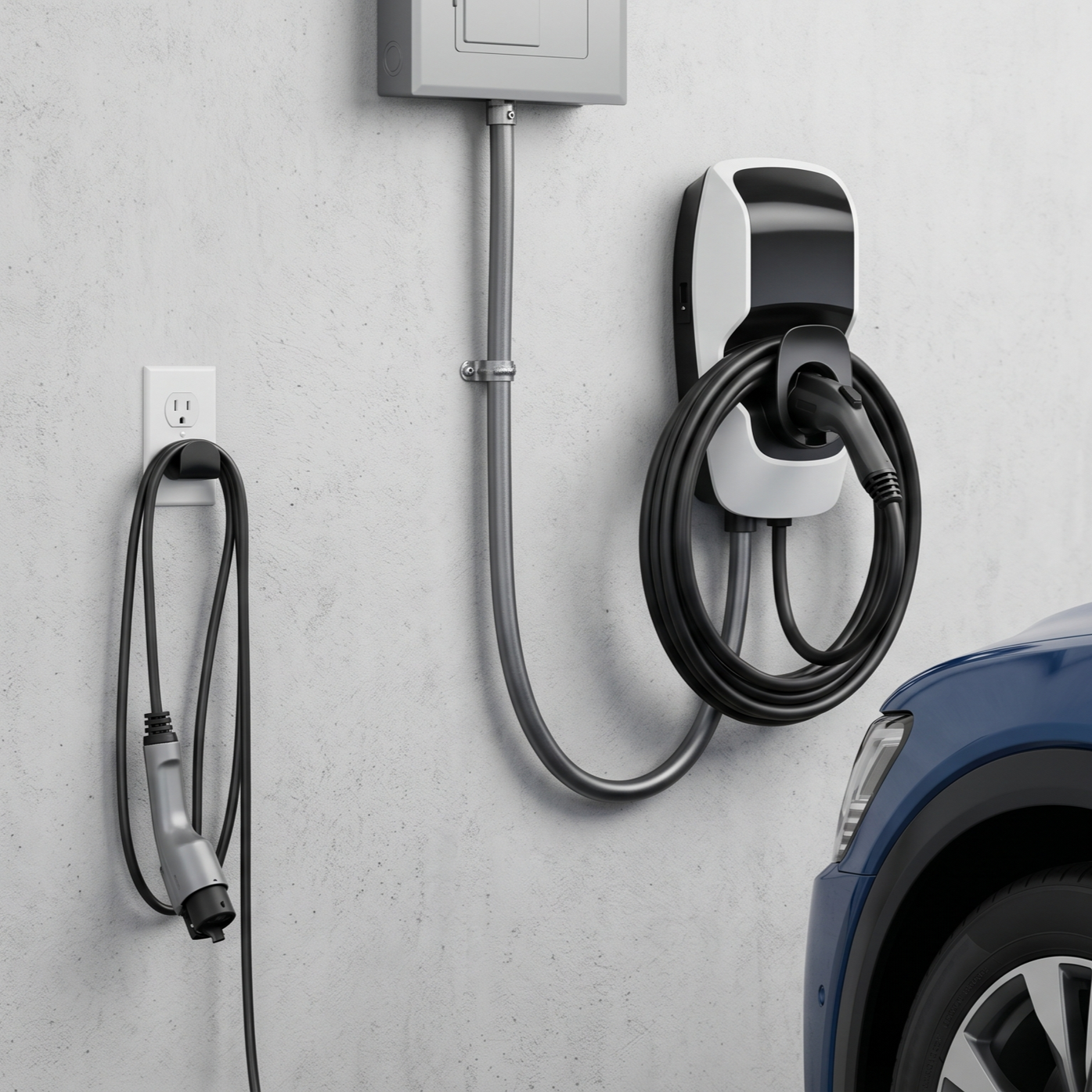
Level 1 charging plugs the cord that came with your car into an ordinary 120-volt household outlet — the same kind your refrigerator uses. It typically draws 12 to 16 amps and adds about 3 to 5 miles of range for every hour it's plugged in. Nothing to install, nothing to buy; you just plug in. The trade-off is speed: charging a depleted battery to full this way can take a day or two, which is why the Department of Transportation notes Level 1 can take 40 to 50-plus hours to bring a battery up to 80 percent.
Level 2 charging uses a 240-volt circuit — the kind that runs an electric dryer or range. With that higher voltage, a Level 2 charger adds roughly 20 to 30 or more miles of range per hour, depending on the charger and the car. That's enough to refill almost any EV overnight, from nearly empty to full, while you sleep. The catch is that it requires a dedicated 240-volt circuit to be installed, which is where an electrician comes in.
The Head-to-Head
| Factor | Level 1 | Level 2 |
|---|---|---|
| Outlet | Standard 120V household | Dedicated 240V circuit |
| Range added per hour | ~3–5 miles | ~20–30+ miles |
| Full charge time | A day or longer | Overnight |
| Installation | None — plug and go | Electrician installs a circuit |
| Up-front cost | Essentially none | Charger plus installation |
| Best for | Light daily driving, plug-in hybrids | Most EV owners, longer commutes |
Which One Fits Your Driving
The honest test is simple: how many miles do you drive on a typical day, and can Level 1 replace them overnight? If you drive only a short commute — say under 30 or 40 miles a day — and the car sits plugged in every night, Level 1's few miles per hour may quietly keep up, and you can skip the installation entirely. Plug-in hybrids, which have small batteries, are often perfectly happy on Level 1.
But if you drive a normal or longer daily distance, Level 1 starts losing ground — you wake up to a car that didn't fully recover, and the deficit compounds over a busy week. That's where Level 2 earns its keep: it reliably refills the battery overnight, no matter how much you drove, so you start every day full. For most full-battery EV owners, that overnight certainty is the whole point of charging at home, and Level 2 is what delivers it.
A few other things tip the decision toward Level 2: a long commute, a household with two EVs sharing one charger, a battery large enough that Level 1 simply can't keep pace, or plans to keep the car for years. And if you ever expect to need the faster charging later, installing the 240-volt circuit now is cheaper than opening the wall twice.
What Level 2 Installation Involves
Level 2 isn't a plug-in upgrade — it's an electrical job. An electrician runs a dedicated 240-volt circuit from your panel to where the car parks, installs the appropriate outlet or hardwires the charger, and confirms your panel has the capacity to handle the new load. That last point matters: an older or already-full panel may need a circuit freed up or, occasionally, a service upgrade, which an electrician will flag before any work starts. Because the circuit is sized to the charger and the install has to meet code, this is the part to leave to a licensed pro rather than improvise — both for safety and so it passes inspection. Where the charger is mounted matters too: the run from the panel to the parking spot affects both the work involved and the cost, so a charger near the panel is usually a simpler job than one across the garage or at the far end of a driveway. A good electrician will walk the route with you, confirm the panel's capacity, and recommend a charger amperage that matches both your car and your home's electrical service, so you don't pay for capacity you can't use or end up with a circuit that limits the charger.
Frequently Asked Questions
It can be, if you don't drive far. Level 1 adds only about 3 to 5 miles of range per hour, so it suits light daily driving and plug-in hybrids that sit plugged in overnight. If you drive a typical or long daily distance, Level 1 often can't fully recharge the car overnight, and you slowly fall behind — which is when Level 2 becomes worth it.
Considerably. Level 1 adds roughly 3 to 5 miles of range per hour on a standard outlet, while Level 2 adds about 20 to 30 or more miles per hour on a 240-volt circuit. In practice, that's the difference between a charge that takes a day or longer and one that refills the battery completely overnight. The exact rate depends on the charger and the vehicle.
Yes. Level 2 requires a dedicated 240-volt circuit run from your electrical panel, sized to the charger, and installed to code. An electrician also checks that your panel can handle the added load, since older or full panels may need a circuit freed up or an upgrade. It's not a DIY plug-in, both for safety and to pass inspection.
Often yes, but not always. A Level 2 charger is a significant load, so the panel needs available capacity. Many homes have room, but an older or already-full panel may need a circuit reallocated or, occasionally, a service upgrade. An electrician will assess your panel before installation and tell you what, if anything, it needs to support the charger safely.
For most EV owners, yes. If you drive a normal daily distance, Level 2's overnight full charge removes the daily worry of whether the car kept up, which Level 1 can't guarantee. It's especially worth it for longer commutes, larger batteries, two-EV households, or if you plan to keep the car for years. Light drivers and plug-in hybrids may do fine on Level 1.
Match the Charger to Your Miles
Level 1 and Level 2 aren't better or worse so much as suited to different driving. Level 1 is the no-cost, plug-and-go option that quietly works for light drivers and plug-in hybrids. Level 2 is the overnight, wake-up-full option that most EV owners end up wanting once the slow trickle wears thin. Tally your typical daily miles, ask whether an overnight Level 1 charge truly covers them, and let that answer — plus an electrician's check of your panel — make the call.
Ready to charge your EV overnight at home? — Get your panel checked and a Level 2 circuit installed safely to code. Ridgeline Electric serves Santa Cruz and the surrounding area. Call (831) 206-5602.
