
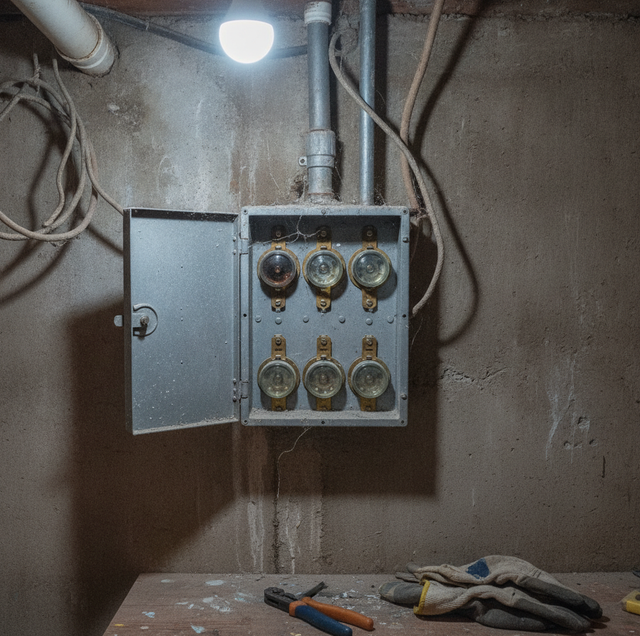
Both a fuse box and a circuit breaker panel do the same core job: they cut power the instant a circuit draws more current than its wiring can safely carry, whether that comes from an overload or a dead short. The difference is what happens at the moment they act, and what you have to do afterward. That difference is the whole reason people ask whether an older panel is worth replacing.
Quick Answer: A fuse box is not automatically unsafe, but it is often older, lower in capacity, and easy to compromise by putting in the wrong fuse. Upgrade when you run out of capacity, blow fuses often, find the panel has been over-fused, need to add circuits, or hit a home sale or insurance requirement. A sound, correctly fused box that meets your loads can stay.
How Each One Actually Protects a Circuit
Inside a fuse, a thin metal strip is sized to carry a set number of amps. Push more current through it than it is rated for, and the strip heats up and melts, breaking the circuit. That is the protection working as designed. The catch is that a fuse is a one-time device: once it melts, it is done, and you replace it with a new one of the same rating before power returns to that circuit.
A breaker does the same job with a mechanism instead of a sacrificial strip. When the current climbs past the rating, the breaker trips and snaps its internal contacts open. Nothing is consumed, so once you find and fix what caused it, you flip the handle back to on, and the circuit is live again. Think of a fuse as a smoke alarm you throw away after every alarm, and a breaker as one you simply reset. That reusable design is also why breaker panels can host specialized protection: ground-fault (GFCI) and arc-fault (AFCI) breakers that watch for shock hazards and dangerous arcing, which a plain fuse cannot do.
A Fuse Box Is Not Automatically the Problem
It is worth being clear, because the internet tends to treat "fuse box" as a synonym for "hazard." An intact fuse box, with each circuit carrying the correctly rated fuse and no signs of overheating or corrosion, is doing legitimate protection work. The fuse itself is a perfectly valid overcurrent device.
The trouble is rarely the concept and usually the condition. Fuse boxes are simply old by now, which means they tend to arrive with a stack of related issues: lower service capacity than a modern home draws, only a handful of circuits, no physical room to add more, and decades of chances for someone to make a well-meaning mistake at the panel. So the real question is not "fuse or breaker" in the abstract. It is whether this particular panel still fits how the home is used today.
The Differences That Decide an Upgrade
A few practical contrasts drive most upgrade decisions:
| Factor | Fuse box | Breaker panel |
|---|---|---|
| After a fault | Fuse melts, must be replaced | Breaker trips, you reset it |
| Typical service capacity | Often on the lower end | Sized to modern whole-home loads |
| GFCI/AFCI protection | Not available | Available as dedicated breakers |
| Adding new circuits | Usually no room to expand | Open slots or subpanel options |
| Insurance and lending | Frequently flagged | Generally accepted |
Read down that table, and the pattern is clear. A fuse box can be perfectly safe on the day you look at it and still be the wrong panel for a household that has added air conditioning, an induction range, and a car that charges in the garage.
Signs It Is Time to Upgrade
Some homes should replace the panel, and some can leave a sound one alone. These are the situations that push toward an upgrade:
- The service does not have enough capacity for what you actually run, so large loads trip or dim the lights.
- You blow fuses often, which usually means circuits are loaded past what they were built for.
- An inspection or an electrician finds the box has been over-fused (more on that below).
- You want to add circuits for a remodel, a workshop, or a garage charger, and there is no room to expand.
- A home sale, refinance, or insurance policy requires updated equipment.
- You want GFCI or AFCI protection that the fuse box cannot provide.
And the flip side matters just as much: if the panel is intact, correctly fused, has capacity for your loads, and nobody needs to add circuits, replacing it is not mandatory. Distinguishing a sound fuse box from an undersized or over-fused one is exactly the judgment call an electrician is there to make.
Why Older Homes Raise the Question More Often
Housing built in earlier decades was wired for earlier lives. A kitchen ran a fridge and a few small appliances, not a microwave, dishwasher, and countertop induction burner all at once. Coastal areas with a lot of older housing stock see this constantly: the panel worked fine for the original owners and simply predates the loads a modern family plugs in. Salt air near the coast can also speed corrosion at electrical connections, which is one more reason an aging panel earns a closer look rather than a shrug.
None of that means an old home needs a panic replacement. It means the odds that the existing panel is undersized, full, or quietly compromised are higher, so the inspection is worth doing before you assume either way.
This Is a Licensed, Permitted Job
Swapping a panel means working at the point where the utility's power enters the house, which is not a weekend project. A panel upgrade is licensed-electrician work, done under a permit and inspection, so the new equipment is verified before it goes into service. That process also catches related issues, like grounding that needs updating or wiring that should be evaluated at the same time.
The one thing you should never do in the meantime is defeat the protection you already have. Match every fuse to its circuit, never size up to stop nuisance blows, and if fuses keep going, treat that as a signal to have the load and wiring looked at rather than a problem to muscle past.
Frequently Asked Questions
Not if it is intact and every circuit carries the correctly rated fuse. The common danger is "over-fusing," where someone puts a 30-amp fuse on a circuit wired for 15 amps to stop it from blowing. The wire is now protected at twice what it can handle, so it can overheat inside the wall while the fuse sits there doing nothing, which is exactly the failure the fuse was meant to prevent.
A breaker trips and resets with a flip of the handle instead of needing a replacement fuse on hand every time. Beyond convenience, breaker panels accept GFCI and AFCI breakers that guard against shock and arc faults at the circuit itself. A standard fuse box has no equivalent for that kind of shock and arc-fault protection.
Many older fuse boxes are rated around 60 to 100 amps of total service. That was plenty for a mid-century household, but it is often tight for today's central air conditioning, electric appliances, and an EV charger running together. In a lot of upgrades, the capacity ceiling is the actual reason to replace, not any fault with the fuses themselves.
Often, yes. Many insurers and lenders flag older fuse panels and may ask for an upgrade or an inspection before they will write or renew a policy. That means a panel working without complaint can still hold up a closing or push premiums higher, which surprises a lot of sellers who assumed "it works" was the whole test.
Usually not. Most fuse boxes have no spare positions and cannot accept modern breakers, so there is simply nowhere to land a new circuit. When you need capacity for a remodel or a new appliance, that generally means replacing the panel rather than squeezing another circuit into the old one.
Not necessarily. Swapping the panel updates the protection and the capacity at the service point, while the home's existing branch wiring in the walls can often stay in place. The exception is very old wiring, such as knob-and-tube, which an electrician may evaluate at the same time to decide whether any of it should be addressed alongside the new panel.
Book a panel inspection — know whether your fuse box can stay or should be upgraded. Ridgeline Electric serves Santa Cruz and the surrounding area. Call (831) 206-5602.
