
You open the door of your main panel, and the cover comes off in your hand. Somebody crammed a tandem breaker into a slot it wasn't listed for. Every position is taken. There's nowhere to land a new circuit for the espresso machine the new tenant wants in suite 102.
That's the moment. When the panel runs out of room before the build-out runs out of work, a subpanel goes from "maybe" to "on the drawings."
And a commercial subpanel looks like a small main panel and lives downstream of one. It gives you extra breaker positions, shorter branch-circuit runs, and a clean place to terminate new loads without rewiring everything that's already in the existing equipment. It's rarely a preference. It's almost always the answer to a specific problem.
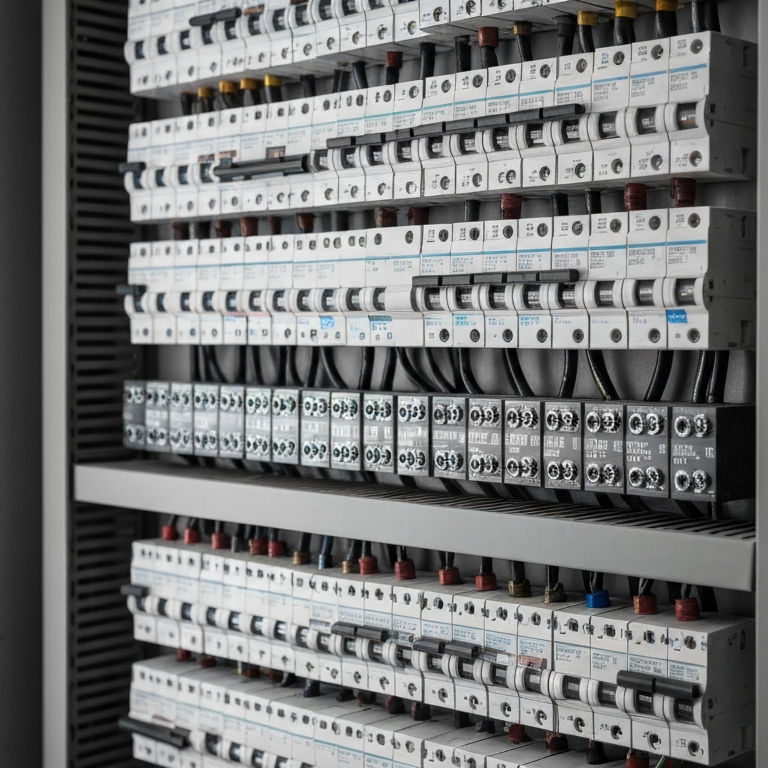
The Four Triggers That Put a Subpanel on the Drawings
One of these four things is happening. Most projects have two of them at once.
The main panel is out of breaker space. Every panel has a fixed number of slots. Tandem breakers can buy back a few positions if the panel is listed for them, but they don't help if the new circuit needs a two-pole breaker for 240-volt equipment. Once the slots are full, the next circuit is served by a subpanel.
The connected load is climbing toward the main panel's rating. A panel rated for 400 amps can't carry an unlimited number of circuits. The total demand has to stay under the panel's continuous capacity, and a new tenant with kitchen equipment, server racks, EV chargers, or shop tools can push that total right up to the line. A separately fed subpanel supplies the new load without overloading the existing distribution system.
A remote part of the building is too far from the main. Long branch-circuit runs cost money twice. The wire has to be sized up for voltage drop, and the labor to route hundreds of feet of conduit through walls and ceilings adds up fast. When a new shop bay, warehouse area, or upstairs suite is far enough away, the math favors running one larger feeder out to a subpanel and branching off locally.
A new tenant wants their own clean distribution. Even on a single-meter building, giving each tenant a labeled subpanel makes future service calls faster and keeps work in one suite from tripping circuits in another. For separately metered spaces, the subpanel is the natural place to land the tenant's loads.
What the Load Calculation Actually Does
Before anyone sizes a subpanel, an electrician runs a load calculation on the proposed loads. Lighting, receptacles, HVAC, motors, kitchen equipment, water heating, EV chargers, server racks — all of it. Continuous loads are counted at 125 percent of their nameplate rating. Loads that will never run at the same time can be counted as the larger value rather than added together.
You end up with two numbers. Connected load is what's wired in. Demand load is what the building actually draws at the same moment. The feeder, the subpanel's main breaker, and the wire size all get picked from the demand load, with a safety margin built in.
In existing buildings, the calculation can sometimes use the building's utility-metered demand to show how much headroom the service has during peak hours. That data sets the ceiling on how much new load the building can absorb without a service upgrade.
Where the Subpanel Goes
But sizing is half the answer. Location is the other half. A subpanel in the wrong place either adds labor, blocks future maintenance, or fails inspection. Four constraints drive the spot.
Working clearance is the open space in front of and around the panel that an electrician needs to safely open the cover and work on energized equipment. Storage, shelving, doors swinging into the space, and HVAC ductwork above the panel are the usual culprits. The clearance has to be there at installation — and stay there for the life of the equipment. That's why panels in storage rooms often get flagged on the next inspection when shelves have crept in.
Dedicated equipment space is the vertical column above the panel that must remain clear of plumbing, ductwork, and anything else that could leak or fall onto the equipment. It's one of the most-violated rules in older commercial spaces, where every other system in the building eventually grows toward the panel room.
Accessibility matters for both code and practicality. The panel has to be reachable without a ladder. Locked rooms need to be coordinated with the facility's emergency plan. The path from the building entrance has to stay clear for emergency responders.
Proximity to the loads is the practical driver. The whole point of a subpanel is to shorten branch-circuit runs and put the breakers near the people using the equipment.
What a Complete Subpanel Scope Looks Like
A scope that actually delivers a working, inspectable subpanel covers more than hanging a panel and pulling a feeder. The full scope typically includes the items below.
| Scope item | What it covers |
|---|---|
| Load calculation and panel schedule | Written calculation showing existing, new, and total demand against the main rating. The panel schedule lists each circuit, its breaker size, conductor size, and the load it serves. |
| Permit drawings and plan check | Single-line diagram covering the main panel, the new feeder, the new subpanel, and the loads it serves. Some jurisdictions require a stamped drawing for larger projects; others accept contractor-prepared documents for smaller work. |
| Feeder installation | Conduit, conductors, and grounding from the main panel to the new subpanel location, sized for demand and voltage drop. |
| Subpanel mount and termination | The panel, the main breaker (if used), branch breakers, and the bonding-screw configuration appropriate for a subpanel (neutral and ground kept separate, bonding screw removed). |
| Branch circuits | The new circuits that feed the loads the subpanel was installed for. |
| Inspection and energization | Coordination with the building department, a rough inspection before drywall, a final inspection after the panel is energized, and a signed permit card for the property file. |
| Arc-flash and equipment labels | Updated labels on both panels showing the available fault current, the date the calculation was performed, and the arc-flash warning. These labels protect the next electrician who opens the equipment. |
What Makes a Subpanel Quote Bigger or Smaller
The same panel can take a half-day or a full week to install. Four things move the price.
| Cost driver | Why it matters |
|---|---|
| Distance from the main panel | More conduit, more wire, more labor through walls and ceilings. A subpanel 30 feet from the main is a different project than one 300 feet away. |
| Conduit path complexity | Open warehouse ceilings are fast. Finished office ceilings with sprinkler grids, lighting, and ductwork are slow. Exterior runs add weatherproofing. |
| Tenant occupancy during the work | A vacant suite is faster than an occupied space that needs off-hours scheduling and protection of finished surfaces. |
| Existing-condition surprises | Older panels often lack accurate as-built drawings. Discovery during demolition may reveal undersized service conductors, missing grounding electrode connections, non-listed splices, or clearance violations that must be corrected before the new subpanel can be energized. |
Frequently Asked Questions
The wiring methods, the load-calculation approach, and the inspection process differ. Residential subpanels usually run in NM cable and use the dwelling-unit calculation method. Commercial subpanels run in conduit, follow the non-dwelling rules, and must meet commercial working-clearance and labeling requirements. Plan check is heavier for commercial work because the documentation requirements are more extensive.
Yes. Any new feeder requires a calculation demonstrating that the existing service can carry the added load. In existing buildings, the calculation can use metered demand data from the utility to show the service's headroom. For multi-charger installations, you'll usually need a load-management plan so the chargers throttle their draw when the building hits peak demand.
Most don't. The subpanel is fed from the building's existing main service. A separate utility service is only needed when the subpanel serves a separately metered tenant in a building configured for multiple services, when the existing service genuinely doesn't have capacity, or when the local jurisdiction requires service-disconnect separation for fire or accessibility reasons.
Modern panelboards are limited by the listing printed on the equipment nameplate — not by a fixed code-imposed number. Many current commercial panelboards are listed for 60, 72, or 84 circuits. The practical limit is usually wall space, main-breaker rating, and connected load. Not slot count.
Yes, as long as the working clearance and dedicated equipment space requirements are met for both panels independently. In tight equipment rooms, this is often the constraint that drives a subpanel to a different wall or room.
Yes. Equipment that's likely to be opened, adjusted, or serviced while energized has to be field-marked to warn the next person who opens it. Newer requirements also call for service equipment to be labeled with the available fault current and the date the calculation was performed. The arc-flash study that produces those labels is a standard scope item on commercial subpanel installations.
Get the Scope Right Before the Build-Out Starts
The cheapest commercial subpanel is the one that gets scoped correctly on day one. A load calculation that catches an undersized service before the permit is submitted saves a redesign mid-build. A site walk that finds a working-clearance violation before the panel is ordered saves a relocation in the middle of the project. Answer four questions before signing a contract — what the new occupancy will draw, what the existing service can support, what local requirements the alteration triggers, and where the equipment actually needs to be served from — and the scope writes itself.
