Can I just screw an LED bulb into my old recessed can and call it done? Sometimes. Often not. The honest answer depends on what's inside that can beyond the bulb, and that's the part most homeowners never see: a housing built decades ago for a 65-watt incandescent flood, running hot, wired to a thermal protector that was engineered around a completely different heat profile than the LED you just installed. Swapping the bulb takes five minutes. Understanding whether that's enough, or whether the can itself needs to come out, is the actual question worth answering.
What's Actually Inside an Old Can
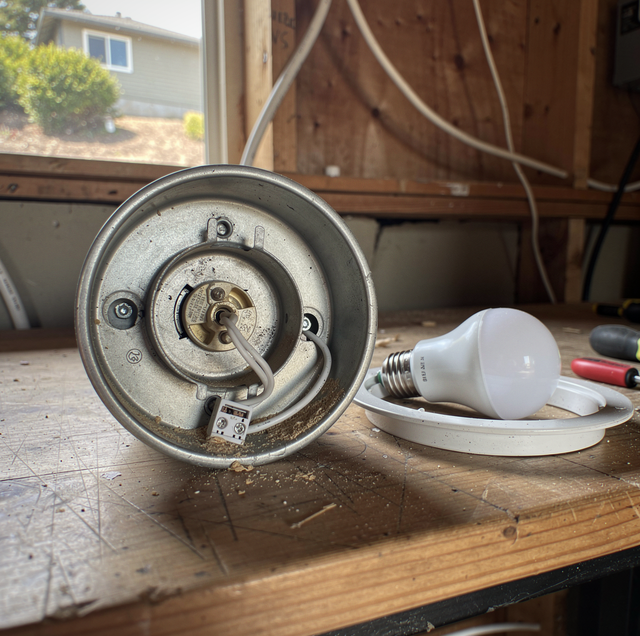
A recessed can light isn't just a hole in the ceiling with a bulb in it. It's a metal housing set into the ceiling framing, wired to the branch circuit, and built around a specific heat-management design for whatever bulb it was meant to hold. Older cans, especially those installed before the mid-2000s, were engineered around incandescent or halogen bulbs that ran hot: 200 to 300 degrees Fahrenheit at the socket was common. To keep that heat from becoming a fire risk, manufacturers built in a thermal protector, a small bimetallic switch that cuts power to the socket if the housing gets hotter than it should.
That thermal protector is calibrated for incandescent-level heat. Drop a modern LED bulb into that same housing and the heat profile changes entirely: LEDs run far cooler at the light-emitting surface, but they generate real heat at the driver, the small electronic component that converts household AC power into what the LED chip needs. In a housing designed with poor airflow around that specific area, driver heat can build up in ways the original thermal protector wasn't designed to sense, since it's watching for a different kind of heat in a different spot. The bulb doesn't overheat the way an incandescent would. The driver behind it might, quietly, in a location the housing's protection system was never built to monitor.
The Difference Between a Bulb Swap and a Real Retrofit
A true LED retrofit kit isn't just a light bulb. It's a trim and light-engine assembly that replaces the entire visible portion of the fixture: the trim ring, the reflector, and the light source become one integrated unit, engineered specifically for LED heat characteristics from the start. Some kits also include a new baffle or gasket that improves the seal between the can and the ceiling, which matters for both light quality (less scatter, more directed output) and for insulation contact rules if the can sits in an insulated ceiling.
An IC-rated retrofit kit is the detail that matters most in a house where insulation touches or is near the can. IC stands for insulation contact, and a can rated for it is built so insulation can safely rest directly against the housing without trapping heat in a way the design didn't account for. A non-IC-rated can needs clearance from insulation, often several inches on all sides, and if that clearance was never maintained in the original install (a common shortcut), the housing has likely been running hotter than its own design intended for years, LED bulb or not.
When the Bulb Swap Is Fine, and When It Isn't
A straight bulb swap into an existing can works reasonably well when the can is already IC-rated, in reasonable physical condition, and simply needs a more efficient light source. In that scenario, an LED bulb rated for enclosed or recessed fixtures (the packaging usually states this directly) drops in and performs close to what a proper retrofit kit would deliver, since the housing was already built with adequate thermal margin.
The swap becomes a poor substitute when any of a few things are true: the can predates IC ratings entirely (common in houses built before the late 1990s), the trim or baffle is damaged or missing, the housing shows scorch marks or a brittle, discolored socket, or the thermal protector has already tripped repeatedly with the old bulb in place. In any of those situations, an LED bulb in the same aging housing doesn't fix the underlying condition of the can; it just puts a more efficient light source into a fixture that was already due for replacement.
Reading the Signs an Old Can Needs More Than a Bulb
A few things point toward a full retrofit or can replacement rather than a bulb swap. A can that cycles off and back on repeatedly (the thermal protector tripping and resetting as it cools) indicates it's running hotter than its design tolerances, regardless of which bulb is installed. Visible yellowing or a brittle feel to the socket and wiring inside the housing signals age-related insulation breakdown that a new bulb won't reverse. A trim ring that's loose, cracked, or missing its gasket lets air (and in an older home, sometimes attic dust or moisture) move through the ceiling penetration in a way a sealed retrofit kit is built to prevent.
A less obvious sign is a faint buzzing or humming from the fixture once an LED bulb is installed. That noise usually traces back to the driver, either inside a retrofit kit or built into the bulb base, vibrating slightly against the housing at a frequency the metal amplifies. A properly seated, correctly rated component is quiet; a mismatched bulb-to-can combination, or a driver working harder than it should because of poor airflow, tends to hum. It's a small clue, easy to dismiss, that's often the first sign of a heat or compatibility problem before the thermal protector starts tripping outright.
Recessed Cans Versus Track Lighting for the Same Space
The retrofit-versus-replace decision sometimes opens a bigger question: whether recessed cans are even the right fixture for a given room going forward. Recessed lighting sits flush with the ceiling and works well for even, ambient light across a room, but every can is a fixed location decided at install and a penetration through the ceiling and any insulation above it. Track lighting mounts a rail to the ceiling surface with individually aimable heads, which trades the clean flush look for flexibility: heads can be repositioned, added, or aimed at specific art or counter areas without new ceiling penetrations. A kitchen remodel that's rethinking the layout anyway is a natural point at which to weigh the two, rather than defaulting to recessed simply because that's what was there before.
So, can a bulb alone finish the job? Only when the can behind it was already sound: IC-rated, undamaged, and quiet under load. That's a question worth answering with the trim ring off, not by guessing from how the room looks once the lights are on, since the housing that actually decides whether a five-minute bulb swap holds up is the one part of the fixture most homeowners never think to check.
Frequently Asked Questions
Some retrofit kits are engineered to be safely used in non-IC housings by managing heat differently within the kit itself, but this has to be confirmed against the specific kit's listing rather than assumed, since installing an IC-only kit into a non-rated can (or the reverse) defeats the thermal design either way.
An LED driver typically dissipates a small fraction of the heat an incandescent bulb of comparable brightness produced, often in the range of a few watts versus 40 to 60 watts, but that heat concentrates in a smaller physical space at the back of the fixture rather than radiating from the bulb itself, which is why airflow design around the driver matters even though total heat output dropped.
Yes, and this is one of the more practical upgrades a retrofit delivers: most kits offer a selectable color temperature, sometimes via a small switch on the kit itself, letting a room shift between a warmer 2700K and a cooler 4000K or higher without buying different bulbs.
Often not. Many retrofit kits are designed to mount into the existing can opening using the housing's own mounting clips or a new trim frame, without enlarging the ceiling hole, which is part of why retrofits are popular for finished ceilings where cutting is disruptive.
Frequently, yes. Older dimmers were designed for higher electrical loads and the different dimming curve of incandescent bulbs, and pairing them with LEDs often causes flickering, buzzing, or a limited dimming range. An LED-rated dimmer, matched to the specific retrofit kit's compatibility list, resolves most of these issues.
A quality retrofit kit's integrated light engine is commonly rated for tens of thousands of hours of use, often outlasting several bulb-swap cycles, though the actual lifespan depends heavily on how much heat builds up around the driver, which circles back to why housing condition and airflow matter as much as the LED component itself.
Schedule a recessed lighting retrofit — get old cans properly upgraded to IC-rated, sealed LED fixtures instead of just a bulb swap. Ridgeline Electric serves Santa Cruz and the surrounding area. Call (831) 206-5602.
